| Trip Length | Realistic Scope | Base and Move Pattern | Best Fit |
| 5 days | London plus one nearby destination | One base; optional day trip | City-first short break |
| 8 days | London and one region, or a fast England–Scotland route | Two or three bases | Highlights with firm priorities |
| 10 days | London, one English stop, and Edinburgh | Three bases; two main moves | Balanced first visit |
| 14 days | Core route plus Highlands or southwest England | Three or four bases | More scenery and depth |
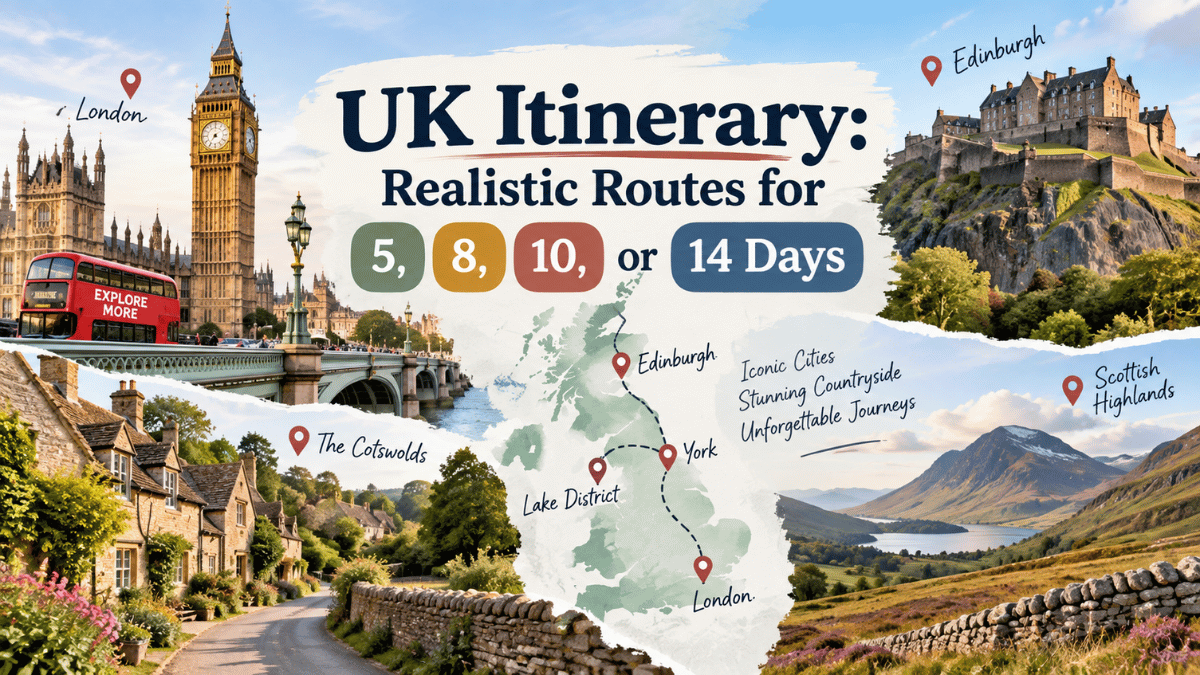
UK Itinerary: Realistic 5, 8, 10, and 14-Day Routes

How Many Days Do You Need for a UK Itinerary
Ten days creates room for three distinct experiences: London, a smaller English city or countryside area, and Edinburgh. Eight days can follow the same outline with fewer stops, but offers little room for delays or spontaneous discoveries. At 14 days, use the extra time for one coherent scenic region instead of more cities. Separate “nights” from “days.” Three nights usually create two full days plus arrival and departure portions. Allocate full days to priority attractions before adding another overnight base.
Use a night ledger before naming more destinations. Write the arrival city beside night one, the departure city beside the final night, and every hotel change between them. Next, label each day as full, partial, or transfer-heavy. This reveals the usable shape of the trip more honestly than a list of dates. If a five-night plan contains two hotel moves, for example, its sightseeing time is much tighter than five complete days. Removing one base can restore an entire relaxed morning or evening.
Build the Core Route Around London and Edinburgh

A practical first route begins in London, continues north through one English stop, and ends in Edinburgh. London deserves at least three nights because its main attractions span several areas. Compare London tours and experiences while leaving space for walking, museums, markets, or a neighborhood evening. Bath, York, Oxford, or the Cotswolds can supply contrast, but choose one. For a 10-day plan, think in blocks: London first, two or three nights in an English base, then Edinburgh. Rail is simplest when the stops sit on a logical south-to-north line. Bath or the Cotswolds may require an extra connection; York makes a natural bridge between the capitals.
Route order should also follow the airports. An open-jaw flight—arriving near one end of the route and leaving from the other—can avoid a long backtrack when practical. If both flights use London, place the capital at the beginning and reserve a final night there, or split the London stay between the start and finish. The second approach adds a hotel change but creates a useful departure buffer. Whichever pattern you choose, do not schedule a remote rural overnight immediately before a long-haul flight.
Travelers who prefer a single organized framework can consider the 8-day England and Scotland tour from London. Its Windsor, Oxford, Highlands, Edinburgh, and Cambridge sweep suits visitors who value broad coverage, while coach travel, hotels, daily breakfast, and selected admissions reduce planning work. The tradeoff is a fast geographic range with substantial transfers; its group style and stated language environment also need to match the traveler.
Recommend Tour

Add Devon and Cornwall When the Coast Is the Priority
The 5-day Devon and Cornwall small-group tour fits travelers who want rugged scenery without driving rural roads themselves. Its London round trip links Winchester and Stonehenge with Exeter, Dartmoor, Cornwall, and Glastonbury by mini-coach. That transport is the key benefit because the route includes places that are awkward to combine quickly by rail. However, food and attraction admissions are excluded, and Tintagel’s steep, uneven approach may not suit every mobility level. Two-night bases reduce packing and make evenings useful. Avoid a late return from Cornwall immediately before an international flight; a final London night creates a calmer finish.
Recommend Tour

Choose the Scottish Highlands for a Scenic Extension
A 4-day Isle of Skye and West Highlands small-group tour is a natural fit for travelers who want organized rural routing after the city portion of their trip. The benefit is a ready-made structure through a region where distances and local roads complicate independent planning. Its limitation is equally important: it consumes four full trip days and follows a group itinerary, so it belongs most comfortably in a 14-day plan rather than a rushed week. If driving, plan around daylight, weather, and rural roads rather than map distance alone. Without a car, use a transport hub and avoid multiple one-night stays. Cornwall and Skye are both rewarding, but combining them in two weeks creates a long diagonal journey.
Recommend Tour

Keep Transfers, Hotels, and Sightseeing in Balance
Allocate attractions by energy as well as geography. Put a timed or high-priority visit early in a full day, then group flexible sights nearby. On transfer days, choose an evening walk, viewpoint, or neighborhood meal instead of a complicated ticketed schedule. Families, travelers with limited mobility, and anyone adjusting to jet lag may need more recovery time than the map suggests. A spare half-day is not wasted; it can absorb rain, transport disruption, or a place that deserves longer than expected.
Protect the two or three experiences that motivated the journey and keep everything else flexible. Build a buffer before a flight, leave an open half-day, and remove a base whenever the plan requires consecutive one-night stops. A realistic itinerary should feel varied, not breathless.
FAQ
How many days are enough for a first UK trip?
Ten days is a strong first-trip balance for London, one English stop, and Edinburgh. Five days suits one main base, while 14 days allows a focused scenic extension without compressing the core route.Can you visit London and Edinburgh in one week?
Yes, if those are the two priorities. Spend several nights in each city and travel between them once. Adding Cornwall, Skye, and multiple English towns would make the same week unnecessarily rushed.Is it better to travel around the UK by train or car?
Trains are usually easier between major cities, while a car or organized tour can improve access to rural coasts, villages, and Highland landscapes. Many successful routes combine the two rather than choosing only one.Should a first UK itinerary include Cornwall or the Highlands?
Choose Cornwall for southwest coast, moorland, and fishing-town character; choose the Highlands for mountain and island scenery. Either works best as a multi-day block, especially on a 14-day trip, rather than as a quick detour.También te puede interesar

Greece Itinerary 10 Days: Athens, Santorini & Meteora Route
03 Nov 2026

Best Time to Visit South Korea: Seasons & Festivals
03 Nov 2026

South Korea 10 Day Itinerary: Seoul, Busan & Jeju Island
03 Nov 2026
Resumen
How Many Days Do You Need for a UK Itinerary
Build the Core Route Around London and Edinburgh
Add Devon and Cornwall When the Coast Is the Priority
Choose the Scottish Highlands for a Scenic Extension
Keep Transfers, Hotels, and Sightseeing in Balance
FAQ
America's 250th Anniversary Mega Sale