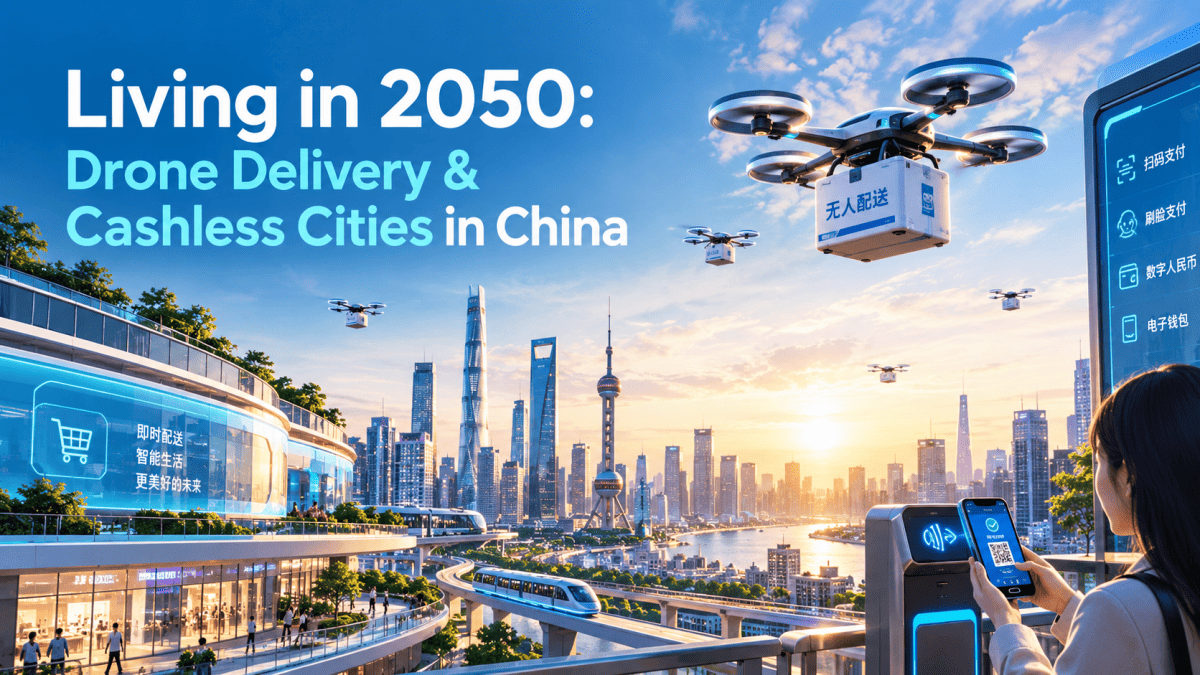
Living in 2050: Drone Delivery & Cashless Cities in China

Zoella20 Sep 2026
Today's early adopters—cities like Shenzhen, Shanghai, and Beijing—already demonstrate how drone logistics and cashless transactions reshape urban life, with implications for efficiency, sustainability, and daily convenience that will only accelerate over the next 25 years.
For travelers planning to experience China's technological landscape today, you can explore China tours that visit innovation hubs, or browse China vacation packages that include stops in cities pioneering these technologies. Tours4fun's guides can help you navigate China's cashless ecosystem and witness drone delivery systems already in operation.
The Current State: China's Technology Foundation in 2026
To understand where China is headed by 2050, we need to examine the technological infrastructure already in place today.
Drone Delivery: Beyond Experiments
China's drone delivery systems have moved far beyond pilot programs. As of 2026:
Meituan, China's food delivery giant, operates autonomous drone delivery routes in Shenzhen, Shanghai, and Beijing. These drones deliver food from restaurants to designated pickup stations in under 15 minutes, navigating urban airspace with precision.
JD.com runs drone delivery networks serving rural areas and suburban communities, covering distances up to 10 kilometers with payloads of 10-15 kilograms. Their drones operate in all weather conditions and have completed millions of deliveries since 2021.
SF Express, China's leading logistics company, has established drone delivery hubs connecting remote mountain communities to urban supply chains. Medical supplies, emergency equipment, and high-value goods move through these aerial networks, bypassing traffic congestion and geographical barriers.
The regulatory framework supports this expansion. China's Civil Aviation Administration has designated specific airspace corridors for commercial drone operations, and cities like Shenzhen have built dedicated drone infrastructure including landing pads, charging stations, and air traffic control systems optimized for unmanned aerial vehicles.
Cashless Society: The Mobile Payment Revolution
China's cashless transition is nearly complete in urban areas. The statistics tell the story:
- Over 90% of urban transactions use mobile payments (WeChat Pay or Alipay)
- Cash acceptance is declining rapidly, with many vendors no longer handling physical currency
- Mobile payments process trillions of yuan annually, dwarfing credit card volumes in Western countries
- Even street vendors and small shops display QR codes for instant payment
The infrastructure supporting this system is robust. WeChat Pay and Alipay have integrated into virtually every aspect of daily life—from paying utility bills and booking appointments to splitting restaurant bills and purchasing public transportation tickets. The systems process billions of transactions daily with near-perfect uptime. 2050 Vision: Drone Delivery Networks
Fully Autonomous Urban Airspace
By 2050, drone delivery will likely operate as a fully integrated layer of urban infrastructure:
Dedicated Air Corridors. Cities will have mapped three-dimensional airspace specifically for commercial drones, with altitude layers designated by delivery type (food, medical, retail) and speed requirements. Air traffic control will be entirely automated, using AI systems that coordinate thousands of simultaneous flights without human intervention.
Vertical Landing Infrastructure. Buildings will be designed with drone landing pads on rooftops and balconies. Residential complexes, office towers, and shopping centers will feature dedicated drone ports where deliveries are received, sorted, and distributed to individual units via internal conveyor systems.
Sub-Minute Delivery Times. With optimized routing and distributed fulfillment centers, delivery times will shrink from today's 15-30 minutes to under 5 minutes for most urban deliveries. Drones will operate 24/7, with night deliveries becoming standard for restocking and emergency supplies.
Swarm Coordination. Advanced AI systems will coordinate drone swarms for large deliveries or complex logistics operations. Multiple drones might work together to transport oversized items or establish temporary delivery networks for events and emergencies.
Rural and Remote Access
Drone delivery will solve China's rural logistics challenges:
Mountain Communities. Villages in remote mountainous regions—areas that currently require hours of driving on winding roads—will receive daily drone deliveries of groceries, medications, and supplies. The economics of drone delivery make serving low-density populations viable in ways that traditional trucking cannot match.
Island Connections. China's thousands of islands will be integrated into mainland supply chains through regular drone routes. Fresh seafood, medical supplies, and emergency equipment will flow between islands and coastal cities without dependence on ferry schedules or weather conditions.
Disaster Response. When earthquakes, floods, or other disasters cut off ground transportation, drone networks will immediately establish emergency supply lines, delivering food, water, medical supplies, and communication equipment to affected areas within hours.2050 Vision: Beyond Cashless
Ambient Payment Systems
The concept of "payment" will evolve beyond conscious transactions:
Biometric Authentication. Facial recognition, palm vein scanning, and gait analysis will replace QR codes and mobile phones. You'll walk into a store, pick up items, and walk out—the system automatically identifies you and charges your account. No phones, no cards, no conscious action required.
Vehicle-Integrated Payments. Autonomous vehicles will handle all transportation-related payments automatically—tolls, parking, charging fees, and even drive-through purchases. Your car becomes a payment agent, settling transactions as you move through the city.
Smart Contracts and IoT. Internet of Things devices will negotiate and execute payments on your behalf. Your refrigerator will order and pay for groceries when supplies run low. Your car will schedule and pay for maintenance when sensors detect wear. Your home will automatically settle utility bills, insurance premiums, and subscription services.
Social Credit and Financial Behavior
China's social credit system will likely integrate more deeply with financial systems:
Behavior-Based Financial Products. Your social credit score—reflecting everything from payment history to civic behavior—will determine interest rates, insurance premiums, and access to financial services. High-scoring citizens will receive preferential rates and expanded credit options.
Real-Time Reputation Systems. Transactions will include reputation components. Paying promptly, leaving reviews, and maintaining good relationships with vendors will build your financial reputation, unlocking better deals and priority service.
Cross-Platform Integration. WeChat Pay, Alipay, and other platforms will merge into unified financial identities. Your payment history, social connections, and behavioral data will create a comprehensive financial profile that follows you across all platforms and services.Impact on Daily Life
Morning Routine in 2050
Imagine waking up in a 2050 Chinese city:
Your smart home has already ordered coffee beans from a local roaster—they'll arrive by drone within 10 minutes. Your refrigerator detected you're low on milk and placed an order automatically. The payment was processed through your biometric profile when you opened the fridge door last night.
You check your schedule. Your autonomous vehicle will arrive in 8 minutes. As you get ready, your home system has already paid for your parking at the destination and reserved a charging spot.
Breakfast arrives via drone—a warm meal from your favorite restaurant, delivered to your balcony landing pad. Payment was processed the moment the drone left the restaurant, charged to your account based on your standing order preferences.
Work and Commerce
The office building you work in has drone ports on every tenth floor. Packages, documents, and supplies flow through the building via internal drone networks. Lunch orders are placed via voice command and delivered to your desk by small indoor drones that navigate hallways and elevators.
Business meetings happen in smart conference rooms that automatically handle scheduling, translation, and payment for services used. When you visit a client's office, your presence is detected, your identity verified, and any applicable fees (parking, meeting room usage, catering) are automatically settled between corporate accounts.
Shopping and Entertainment
Physical stores still exist, but they're showrooms and experience centers. You try on clothes, test electronics, sample food—but purchases are made digitally and delivered by drone within minutes. The store doesn't handle inventory or payment processing; it's purely for customer experience.
Entertainment venues use biometric payment systems. You walk into a concert, stadium, or theme park—facial recognition validates your ticket, charges your account, and tracks your purchases inside. No tickets, no cash, no cards. You leave, and everything is automatically settled.Implications for Visitors and Tourists
Navigating China's Cashless Ecosystem Today
For travelers visiting China now or in the near future, the cashless reality presents both opportunities and challenges:
Payment Setup. Visitors need to set up WeChat Pay or Alipay before arrival. These apps link to international credit cards and allow tourists to participate in China's cashless economy. The setup process takes about 15 minutes and requires passport verification.
Cash Becoming Obsolete. While cash is still technically legal tender, many vendors—especially in cities—don't handle it. Some may refuse cash entirely, not out of malice but because they've optimized their operations for digital payments and don't have change or cash handling procedures.
Tourist-Friendly Solutions. Hotels, major attractions, and international businesses typically accept multiple payment methods. However, smaller restaurants, local markets, and transportation options may only accept mobile payments.
Experiencing Drone Delivery
Tourists can already experience drone delivery in select cities:
Shenzhen. Visit the Longhua district, where Meituan operates drone delivery stations. Order food via the app and watch drones land at designated pickup points. The entire process—from order to delivery—takes about 15 minutes.
Shanghai. Certain parks and commercial areas have drone delivery pilot programs. Check local apps for available drone delivery zones.
Beijing. The Daxing district features drone delivery for select restaurants and retailers. Hotels can help you arrange experiences where you order via drone and receive deliveries.
Future Tourism in a High-Tech China
By 2050, tourism in China will be transformed by these technologies:
Seamless Arrivals. Airport immigration and customs will use biometric scanning—no passports, no forms, no lines. Your facial profile and travel documents will be pre-registered, and you'll walk through automated gates that verify your identity in seconds.
Drone-Delivered Luggage. Hotels will receive your luggage via drone from the airport, with your bags arriving at your room before you do (or shortly after). No baggage claim, no waiting for porters.
Personalized Experiences. AI systems will track your preferences, dietary restrictions, and interests, automatically arranging transportation, dining, and activities. Payments will be handled invisibly in the background.
Language No Barrier. Real-time translation earpieces will eliminate language barriers. Your device will translate conversations with locals, read signs, and explain cultural contexts as you explore.Challenges and Considerations
Privacy and Surveillance
The convenience of 2050's technology comes with privacy trade-offs:
Constant Monitoring. Biometric payment systems, facial recognition, and location tracking mean your movements and transactions are constantly recorded. The state and corporations have unprecedented visibility into individual behavior.
Data Security. With everything digitized, cybersecurity becomes critical. Identity theft, account hacking, and system breaches could have devastating consequences when your entire financial and social life depends on digital systems.
Opt-Out Difficulties. As cash disappears and manual processes are eliminated, choosing not to participate in digital systems becomes increasingly difficult. The elderly, privacy advocates, and those without digital access may find themselves excluded from basic commerce.
Digital Divide
Not everyone benefits equally from technological advancement:
Rural-Urban Gap. While cities enjoy drone delivery and seamless payments, rural areas may lag in infrastructure investment. Remote communities might have limited drone service or slower adoption of new payment technologies.
Generational Differences. Older generations who didn't grow up with these technologies may struggle to adapt. Training programs and simplified interfaces will be essential to ensure inclusive access.
Economic Displacement. Traditional delivery drivers, cashiers, and retail workers face unemployment as automation replaces their roles. Economic transition programs and new job creation will be critical social challenges.
Environmental Impact
Drone delivery and digital systems have environmental implications:
Energy Consumption. Thousands of drones flying daily consume significant electricity. The environmental benefit depends on China's energy mix—renewable sources make drone delivery greener, while coal-powered grids offset efficiency gains.
Electronic Waste. The rapid evolution of payment devices, drones, and smart infrastructure generates substantial electronic waste. Recycling programs and sustainable manufacturing will be essential.
Noise Pollution. Urban drone networks create constant background noise. Noise reduction technologies and flight path planning will be necessary to maintain livable urban environments.Preparing for China's Technological Future
For Travelers Planning Visits
If you're planning to visit China and experience its technological landscape:
Learn the Payment Systems. Download WeChat Pay and Alipay before your trip. Link your international credit card and verify your account. Practice using the apps before you arrive so you're comfortable with QR code scanning and mobile payments.
Bring Backup Payment Methods. While cash is increasingly useless, having a backup credit card or emergency funds is wise. Technology failures, while rare, do occur.
Visit Innovation Hubs. Cities like Shenzhen, Shanghai, Beijing, and Hangzhou are at the forefront of these technologies. Consider China tours that specifically visit tech companies, innovation districts, and smart city demonstrations.
Embrace the Experience. Rather than resisting the cashless reality, lean into it. The convenience is remarkable once you're set up. Order food by drone, pay with your face, and experience the seamlessness of China's digital ecosystem.
For Long-Term Residents and Expats
If you're planning extended stays or relocation:
Digital Identity Setup. Ensure your digital identity is properly established—biometric registration, bank account linkage, and social credit system enrollment. These systems are foundational to participating in modern Chinese society.
Stay Current. Technology evolves rapidly. Keep your apps updated, learn new features as they're released, and adapt to changing systems. What works today may be obsolete in two years.
Understand the Social Contract. China's technological convenience comes with acceptance of surveillance and social credit systems. Understand what you're agreeing to and how your data is used.Final Thoughts
China's trajectory toward drone delivery networks and fully cashless cities represents one of the most ambitious technological transformations in human history. By 2050, the conveniences we consider cutting-edge today—mobile payments, drone food delivery, facial recognition—will seem primitive compared to the ambient, invisible systems that will govern daily life.
For travelers and tourists, experiencing China's technological present is both fascinating and challenging. The convenience is remarkable once you're set up, but the learning curve is steep, and the cashless reality can feel exclusionary if you're not prepared. Understanding these systems before you arrive, setting up payment apps, and embracing the digital ecosystem can turn a frustrating visit into a futuristic one.
Whether you're planning a short tourist visit or considering long-term engagement with China's technological landscape, the key is adaptation. The future isn't coming to China—it's already here, operating at scale, reshaping how 1.4 billion people live, work, and interact. Witnessing this transformation firsthand is one of the most compelling reasons to visit China in the 2020s and beyond.
FAQ
Can tourists use drone delivery services in China?
Yes, in cities where drone delivery operates (primarily Shenzhen, Shanghai, and Beijing), tourists can use these services if they have WeChat Pay or Alipay set up. Download the relevant apps (Meituan, JD.com, or Ele.me), set up payment, and order from restaurants or retailers offering drone delivery. Your hotel concierge can help you navigate the process.What happens if I don't have a smartphone or can't use mobile payments?
This becomes increasingly difficult in China. While cash is technically still legal tender, many vendors don't accept it. If you cannot use mobile payments, you'll face significant limitations in dining, shopping, and transportation. Consider traveling with a companion who can handle payments, or staying in international hotels that accept traditional payment methods.Are drone deliveries safe? What about accidents?
Drone delivery systems have multiple layers of safety. Drones operate in designated airspace corridors, have collision avoidance systems, and are monitored by centralized air traffic control. Accident rates are extremely low—lower than car accidents per mile traveled. In the rare event of a drone malfunction, systems are designed to land safely or deploy parachutes.How does China's social credit system affect foreigners?
Foreigners are generally not enrolled in the social credit system in the same way as Chinese citizens. However, your behavior in China (traffic violations, contract violations, legal issues) can be recorded and may affect your ability to obtain visas, rent property, or access certain services. Maintaining good standing is important for long-term stays.Will I need to speak Chinese to use these technologies?
Most payment apps have English interfaces, and major services in tourist areas accommodate English speakers. However, smaller vendors, local restaurants, and transportation options may only have Chinese interfaces. Translation apps and learning basic Chinese phrases will help you navigate these situations.