Day 1: Landing in Cairo
You come out of arrivals, and someone is holding a sign with your name on it. The transfer is a private air-conditioned vehicle, the check-in happens with a representative beside you rather than at a counter alone, and the evening ends with a short briefing: pick-up times for each day, confirmed one at a time. Ask your questions now, because mornings start early from here.
Nothing else is scheduled, and that is deliberate. Cairo traffic plus a long flight is enough for one day.

Day 2: Giza, the Grand Egyptian Museum and Old Cairo
This is the heaviest day of the trip and the one worth defending. Breakfast at the hotel, then a guide and a driver for the whole day: the plateau first, the museum second, the old city on the way back.
The Plateau in the Morning
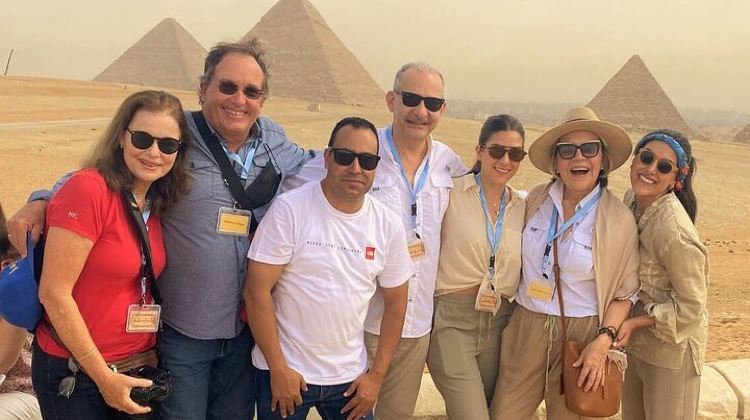
The Great Pyramids of Cheops, Chephren and Mykerinus stand on one plateau, with the Sphinx and the Valley Temple at its edge. You walk between them rather than drive, so the morning is spent on your feet. Plan on a morning, not ninety minutes, because the scale does not translate in a photograph and the walk from one pyramid to the next takes longer than it looks.

The Grand Egyptian Museum
The museum is why Day 2 cannot be cut much shorter. It is a full museum rather than a wing of one, and the size is what surprises people who expected a single hall. Two hours gets you through; three hours gets you a visit.
Old Cairo on the Way Back
The last stop is the older part of the city, where the Hanging Church and the Mosque of Amr ibn al-As are both on the afternoon's list. It is a quiet hour after a loud morning, and it is the piece most itineraries drop.
Day 3: Fly South to Aswan and Board the Ship
Check out after breakfast and fly to Aswan, where a vehicle takes you to the cruise ship in time to board before lunch. The cabin is yours until Luxor. Unpack once and stop thinking about luggage. The ship does not move on that first night, which is a kindness: you get the river view without the engine noise while your body catches up with the time change.
The afternoon belongs to the Aswan High Dam and the Temple of Philae, which sits on Isis Island and is reached by boat. Both visits are short. Dinner is on board, and the ship stays in Aswan overnight.

Day 4: Kom Ombo, Edfu and a Long Sail
Breakfast on board while the ship moves to Kom Ombo, where the temple is shared by two gods, Sobek and Haroeris. It is a compact site with a river view, and it takes less time than you expect.
Then Edfu and the well-preserved Temple of Horus, with lunch on board between the two stops. Afternoon tea comes while the ship sails to Esna, and that stretch is the one to spend on the top deck doing nothing at all. Dinner and overnight on board.
Day 5: Luxor, Both Banks in One Day
The ship reaches Luxor in the morning, and the day splits in two: the West Bank early, the East Bank after lunch. Why the split? Because the west side is where the heat and the crowds both land first.
The West Bank
The Valley of the Kings is a set of tombs cut into a hillside, and the painting inside them is the reason to walk in rather than photograph a doorway. Then the temple of Queen Hatshepsut at Deir el-Bahari, built into the cliff, and the Colossi of Memnon standing in a field on the way back. Three stops, one morning, almost no wasted driving.
Luxor Temple After Lunch
Lunch on board, then Luxor Temple, begun by Amenhotep III and finished by the kings who followed him, with a granite shrine at the back for Alexander the Great. It is a walk-through rather than a climb, which is what you want by four in the afternoon. Overnight on board, one last time.

Day 6: Off the Boat, East to the Coast
Breakfast on board, then off the ship and east toward the sea. The land changes on the way: irrigated fields, then gravel, then rock and sky until the water appears.
The afternoon is free, and the arrival is the work of the day. Hurghada is a resort town strung along a beach, and the Red Sea is the reason it exists. Drop the bags, walk to the water before you do anything else, and let the first look do its work; the trip changes key at that point.
Day 7: The Reef
A boat out to the reef is the standard day here, and it is worth taking the early departure. Snorkeling is not a compromise here; the reef is the reason people come. Divers go deeper and see more, but the first twenty minutes explain why the sea has the reputation it does.
Book it through the hotel the night before, pick a boat with a small group, and be back at the pool by late afternoon. Sunburn is what ruins Day 8.
Day 8: Nothing, on Purpose
This is the day the trip needs and the day most people try to fill. Do not fill it. Sleep late, eat a long breakfast, walk the beach in the late afternoon when the light comes in sideways.
If sitting still is not your thing, there are over-day trips from Hurghada back to Luxor for a balloon ride at dawn and a felucca sail on the river. It is an odd way to spend a rest day, and it works.
Day 9: Cairo Again, and the Bazaar
Back to Cairo, check in, and give the afternoon to Khan El Khalili. The bazaar is the kind of place where the shopping is half the point, and the walking is the other half.
Go late, when the lanes are lit and the shops are awake, and leave when you have had enough rather than when you have seen everything.

Day 10: The Airport Run
Breakfast, then the transfer to Cairo International Airport. If the flight leaves in the evening, the morning is free for a slow coffee and a last look at the river from the hotel window.