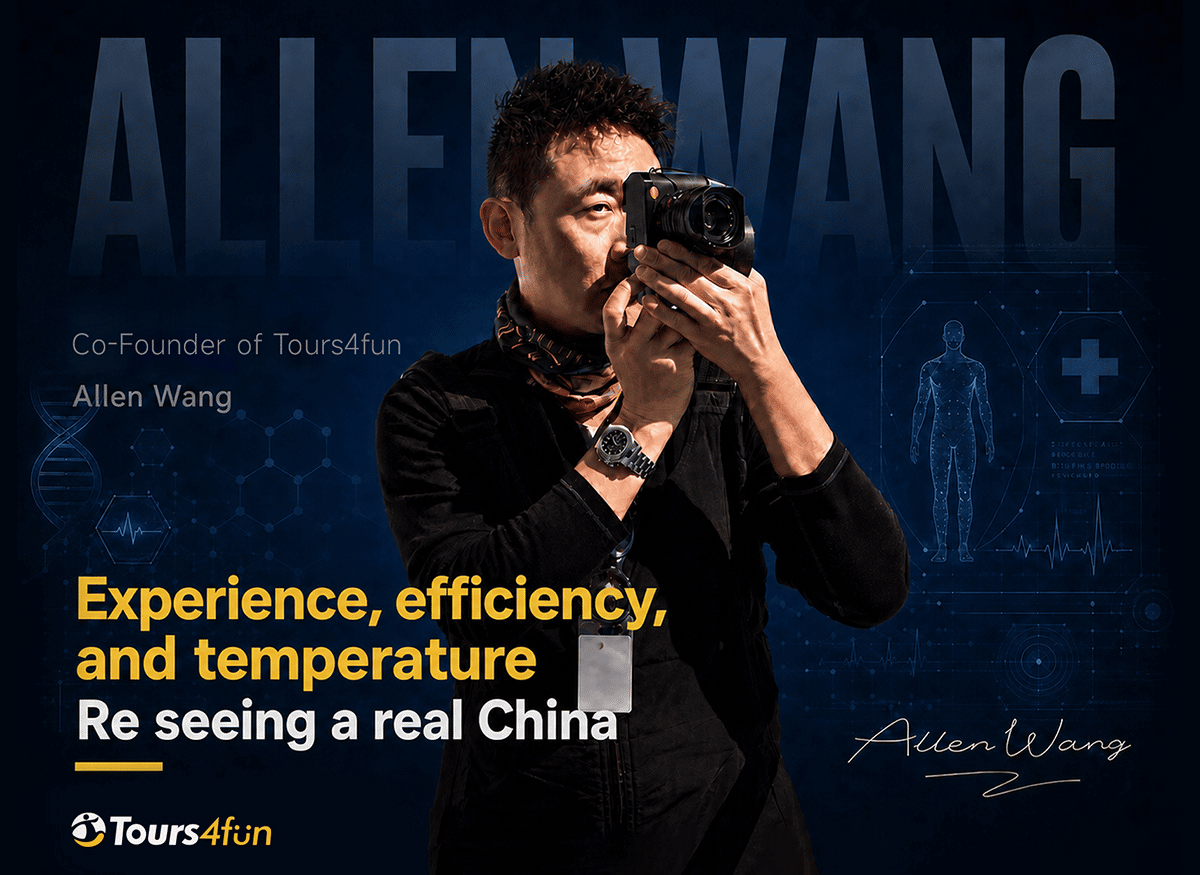
LOS ANGELES — For many overseas Chinese, returning to China is familiar. Understanding how the country has changed is something different. That distinction has become an increasingly important theme for Allen Wang, co-founder of Tours4fun, who has lived in Los Angeles for more than 20 years while maintaining close ties with China. After sharing his thoughts publicly in a recent video, Wang received messages from longtime friends, classmates, travel industry peers, and members of the Chinese American community. Many encouraged him to continue serving as a bridge between China and the wider world. Their responses led him to a larger question: why are so many overseas Chinese interested in rediscovering China today?
Tours4fun Co-Founder Allen Wang on Rediscovering China Today


Returning to China Is Not the Same as Understanding It
Many overseas Chinese already travel back to China regularly. High-speed rail, mobile payments, electric vehicles, artificial intelligence, and rapidly changing city skylines are no longer surprising to frequent visitors. But Wang believes familiarity can sometimes hide how much has changed. Someone may see new infrastructure or use new technology without fully understanding the systems, habits, and social changes behind them. For people who left China 10, 20, or even 30 years ago, their mental picture of the country may still be shaped partly by the China they remember rather than the China that exists today. Wang sees that gap as one reason overseas Chinese are increasingly interested in taking a fresh look at the country.
A Medical Experience That Highlighted Different Approaches
One recent experience made that idea especially tangible. A close friend of Wang's in Los Angeles told him about a medical emergency involving his four-year-old child. After a family ski trip to Big Bear Lake in Southern California, the child developed a persistent high fever. The family visited several medical providers in Los Angeles, including a children's hospital, and testing ruled out COVID-19 and influenza. Because the symptoms were not typical, however, doctors were initially unable to reach a clear diagnosis.
The family continued monitoring the child's condition while waiting for further evaluation and referrals. By the seventh day, the child remained seriously ill. The family then shared the child's symptoms and test results with a pediatrician they knew in China. After reviewing the information, the doctor raised concern about possible Kawasaki disease and suggested that the condition could require timely medical attention. The family decided to fly to Shanghai. After arriving, they went to Shanghai Children's Medical Center, where doctors reviewed the symptoms and test results and began treatment based on suspected atypical Kawasaki disease. According to Wang, the child's condition improved significantly after treatment. A later cardiac ultrasound identified minor abnormalities that would require continued monitoring.
The family continued monitoring the child's condition while waiting for further evaluation and referrals. By the seventh day, the child remained seriously ill. The family then shared the child's symptoms and test results with a pediatrician they knew in China. After reviewing the information, the doctor raised concern about possible Kawasaki disease and suggested that the condition could require timely medical attention. The family decided to fly to Shanghai. After arriving, they went to Shanghai Children's Medical Center, where doctors reviewed the symptoms and test results and began treatment based on suspected atypical Kawasaki disease. According to Wang, the child's condition improved significantly after treatment. A later cardiac ultrasound identified minor abnormalities that would require continued monitoring.
One Case, Two Different Healthcare Perspectives
Wang is careful not to present the experience as evidence that one country's healthcare system is better than the other's. A single medical case cannot represent either the U.S. or Chinese healthcare system. The United States remains home to many of the world's leading medical research institutions, specialists, and advanced treatments, particularly for rare and complex conditions. China's healthcare system also faces challenges, including uneven regional resources and concerns about unnecessary testing or treatment in some settings. What stood out to Wang was not which system was better, but how differently two healthcare environments could approach uncertainty. In the United States, medical care often places strong emphasis on evidence, established procedures, observation, referral systems, and avoiding unnecessary intervention. That caution can be valuable in many situations.
In China, particularly at major urban hospitals, doctors may encounter extremely high patient volumes. Over time, that exposure can give experienced clinicians familiarity with a wide variety of disease presentations. In some cases, physicians may be more willing to form an early working diagnosis based on symptoms, clinical experience, and available test results. Both approaches involve trade-offs. For Wang, the episode illustrated a broader lesson: understanding modern China requires looking beyond simple comparisons and paying attention to how institutions operate in everyday life.
In China, particularly at major urban hospitals, doctors may encounter extremely high patient volumes. Over time, that exposure can give experienced clinicians familiarity with a wide variety of disease presentations. In some cases, physicians may be more willing to form an early working diagnosis based on symptoms, clinical experience, and available test results. Both approaches involve trade-offs. For Wang, the episode illustrated a broader lesson: understanding modern China requires looking beyond simple comparisons and paying attention to how institutions operate in everyday life.
China's Advantages Are Changing
For decades, discussions about China's economic strengths often focused on familiar themes: a large population, relatively low costs, and manufacturing capacity. Those factors still matter, but Wang believes today's China increasingly demonstrates a different set of capabilities. Among them are the ability to accumulate experience quickly, organize resources at scale, and move new technologies into everyday life. High-speed rail is one visible example. So are electric vehicles, mobile payment systems, logistics networks, digital services, and increasingly, artificial intelligence. But Wang argues that these changes should not be understood only through technology. They also affect how people shop, commute, receive services, travel between cities, access information, and interact with businesses. For overseas Chinese who remember an earlier stage of China's development, those changes can be easy to underestimate.
Looking Beyond Old Assumptions About China
Wang believes rediscovering China requires avoiding two extremes. China should not be viewed only through nostalgic memories or optimistic narratives about rapid development. Nor should it be reduced to negative stereotypes or geopolitical headlines. The same principle applies to the United States. After more than two decades of living in Los Angeles, Wang has seen firsthand the strengths of American society as well as practical challenges involving healthcare, education, infrastructure, and everyday efficiency. His conclusion is not that one system consistently outperforms the other. Instead, he argues that each society reflects different priorities, strengths, constraints, and trade-offs. For travelers and overseas Chinese alike, understanding those differences requires direct observation.
Overseas Chinese Can Serve as a Bridge Between Two Worlds
Wang believes overseas Chinese occupy a particularly valuable position in this conversation. Many understand Chinese culture from personal experience while also having spent years or decades living in North America, Europe, Australia, or other parts of the world. That perspective can make it easier to see both similarities and differences without relying entirely on secondhand narratives. For Wang, this role increasingly extends beyond tourism. Tours4fun was built around helping travelers discover unfamiliar destinations more easily. Today, he sees travel as one part of a broader opportunity to help people understand modern China through direct experience. That includes not only famous attractions, but also cities, technology, healthcare, education, industries, young people, and the everyday decisions made by ordinary families.
Beyond Sightseeing: Seeing How China Actually Works
For international visitors, understanding China today may require going beyond traditional sightseeing. Historic landmarks, national parks, food, museums, and cultural attractions remain important parts of any trip. But Wang believes modern China is also worth experiencing at the level of everyday life. That could mean taking a high-speed train between cities, using local digital services, visiting technology districts, walking through residential neighborhoods, spending time in local markets, or simply observing how people work, eat, shop, and socialize. These experiences can reveal changes that are difficult to understand through articles, videos, or social media alone. They can also help visitors see China as more than a collection of famous landmarks.
A Broader Mission for Tours4fun
As Tours4fun expands its focus on bringing more international travelers to China, Wang sees an opportunity for the company to play a broader role. The goal is not simply to sell trips to China. It is to help travelers encounter the country directly and form their own understanding of what they see. That means presenting China in a way that acknowledges both its rapid development and its complexity. It also means creating opportunities for visitors to experience the country through its people, cities, technology, culture, and daily life. For Wang, that idea is closely connected to his own experience of living between China and the United States for more than two decades.
Bringing China and the World Closer
The physical distance between China and North America can be crossed in a matter of hours. The distance created by assumptions, outdated impressions, and limited direct experience is harder to overcome. Wang believes travel can help close that gap. For overseas Chinese, that may mean returning with a willingness to see familiar places differently. For international visitors, it may mean experiencing modern China firsthand rather than relying entirely on what they have heard from others. And for Tours4fun, it represents a continuation of a mission that has evolved over more than 20 years: helping people cross borders, encounter different cultures, and better understand the world on the other side.
También te puede interesar

Costa Rica Family Adventure Tour | Tours4fun Customer Story
19 Oct 2026

Alaska Family Tour with Kids | Tours4fun Customer Story
16 Oct 2026

Guangzhou and the Pearl River Delta: Dim Sum, Lingnan Gardens and Macau
14 Oct 2026
Resumen
Returning to China Is Not the Same as Understanding It
A Medical Experience That Highlighted Different Approaches
One Case, Two Different Healthcare Perspectives
China's Advantages Are Changing
Looking Beyond Old Assumptions About China
Overseas Chinese Can Serve as a Bridge Between Two Worlds
Beyond Sightseeing: Seeing How China Actually Works
A Broader Mission for Tours4fun
Bringing China and the World Closer
America's 250th Anniversary Mega Sale