All four formats drive the same two roads out of Tokyo and break the day in different places. What follows is how each one spends its hours, and where the seams show.
One-Day Coach Tour
You buy a seat, a guide, and a fixed list of stops. Day tours in this category leave Tokyo in the morning, run a loop through Yamanashi, and put you back the same evening. The stop lists differ. Some build the day around the Lake Kawaguchi cable car. Some build it around Arakurayama Sengen Park and Oshino Hakkai. Others add the Hikawa Timepiece Store and the Lawson at Kawaguchiko Station Square, which has become a photo stop in its own right. Many of these runs depart daily, carry a guaranteed departure label, and allow free cancellation several days before travel, and live guides usually cover English, Japanese, Korean and Chinese.
The trade-off is pace. A coach day might give you 40 minutes at one stop and 90 at the next, and the weather does not follow the schedule. If cloud sits on the summit at mid-morning, there is no later chance that day. Most one-day runs also skip the Hakone coast, and you eat dinner back in Tokyo.

Two-Day Onsen Trip
This format is built for travelers with one spare day who would rather not see the mountain from a car park. Departure is JR Tokyo Station's Marunouchi North Exit at 08:00 or Shinjuku MODE Gakuen at 08:30, and hotel pickup runs from 07:00 to 08:30 across seven central wards: Shinjuku, Chiyoda, Chuo, Taito, Minato, Shibuya and Bunkyo. Addresses in Toshima, Nakano, Sumida, Koto and Edogawa fall outside that zone, so you would reach a meeting point on your own.
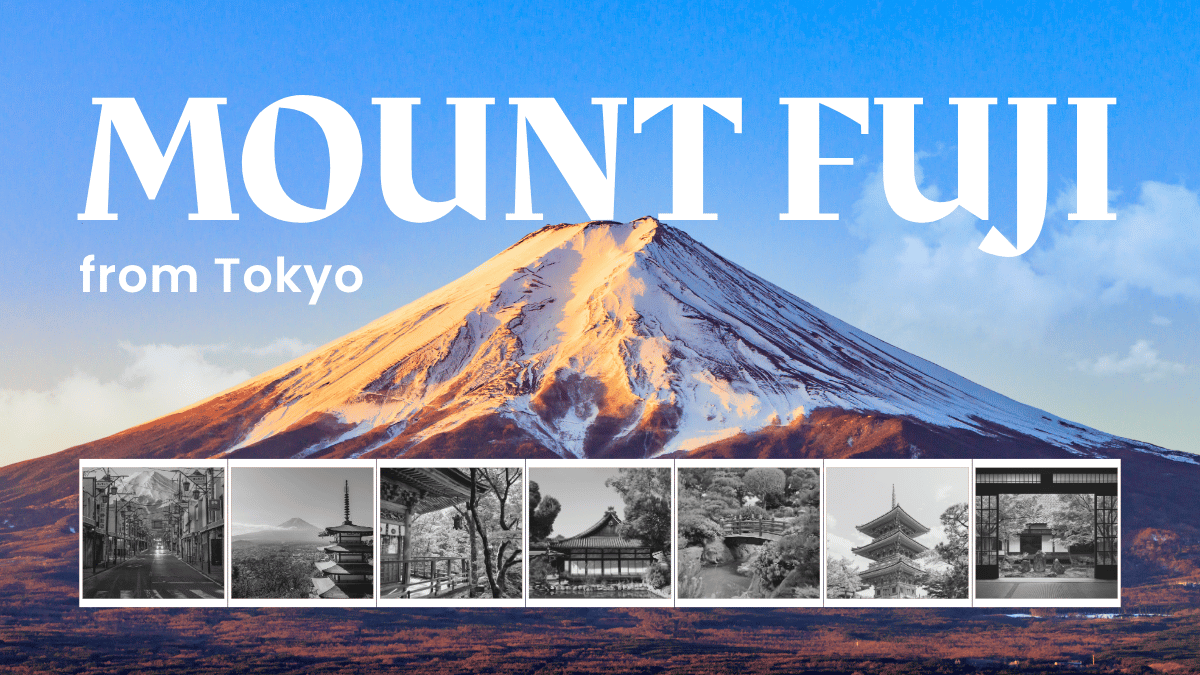
The Fuji stop changes with the calendar, and that detail decides your date. From 26 April to 30 November, the coach climbs to the 5th Station at 2,305 m for about 40 minutes and skips Arakurayama Sengen Park. From 1 December to 25 April it does the opposite: about 60 minutes at Arakurayama Sengen Park, 397 steps up to the five-story Churei Pagoda, with Fujiyoshida laid out below, and no 5th Station. Those two views are not interchangeable, and no booking gets you both on a single departure.
Midday is the lake. The coach stops at the Kawaguchiko Ropeway for about 90 minutes of free time that includes lunch at your own cost, and the cable car up to the 1,075 m deck is a separate JPY 1,200 round trip for reference, paid on the spot. If the cable car is down for weather or the queue is too long, the stop becomes time at the lake shore instead. The afternoon moves to Hakone: about 40 minutes at Owakudani, the volcanic valley where the black hot spring eggs are sold, then Lake Ashi and the Floating Torii Gate of Hakone Shrine. The night is at a hot spring hotel in Izu, with dinner and breakfast included. Day two runs along the coast to Kamakura and Enoshima on the Enoden train.
Group size is capped at 50 travelers, guides speak English, Japanese and Chinese, and the two-day trip is priced at $574.70 per person. What that buys beyond transport is a bed near the mountain and a morning that a day tour cannot offer.
DIY Train and Bus
The independent version of the same road is a highway bus or a train to Kawaguchiko, then a local bus for the final stretch, with your own calls on where to stand when the mountain appears. None of it is difficult. It simply carries no slack: a missed connection costs you the stop, and the seasonal switch between the 5th Station and Arakurayama Sengen Park is yours to track, along with the cable car ticket and the weather call.
What you gain is time where you want it. Two hours at one lake instead of 40 minutes at a station. The chance to wait out a cloud bank that a coach cannot wait out. A trip built around light rather than a timetable. Travelers fitting the mountain into a longer Japan tour, or shooting photographs for a living, tend to accept the planning in exchange for that freedom.
Private Car
A private car is the same geography with the logistics removed. The driver collects you at the hotel, holds the luggage, and works the stops in an order that suits your group rather than a coach manifest. For four to six people with bags, or for parents who cannot manage 397 steps at a fast pace, that is the difference between a comfortable day and a long one.
The bill is per vehicle, so the per-person figure drops as the group grows and looks very different for a couple traveling alone. You also hand route decisions to the driver, which means the calendar still wins: a private car in July still goes to the 5th Station, not to the pagoda.