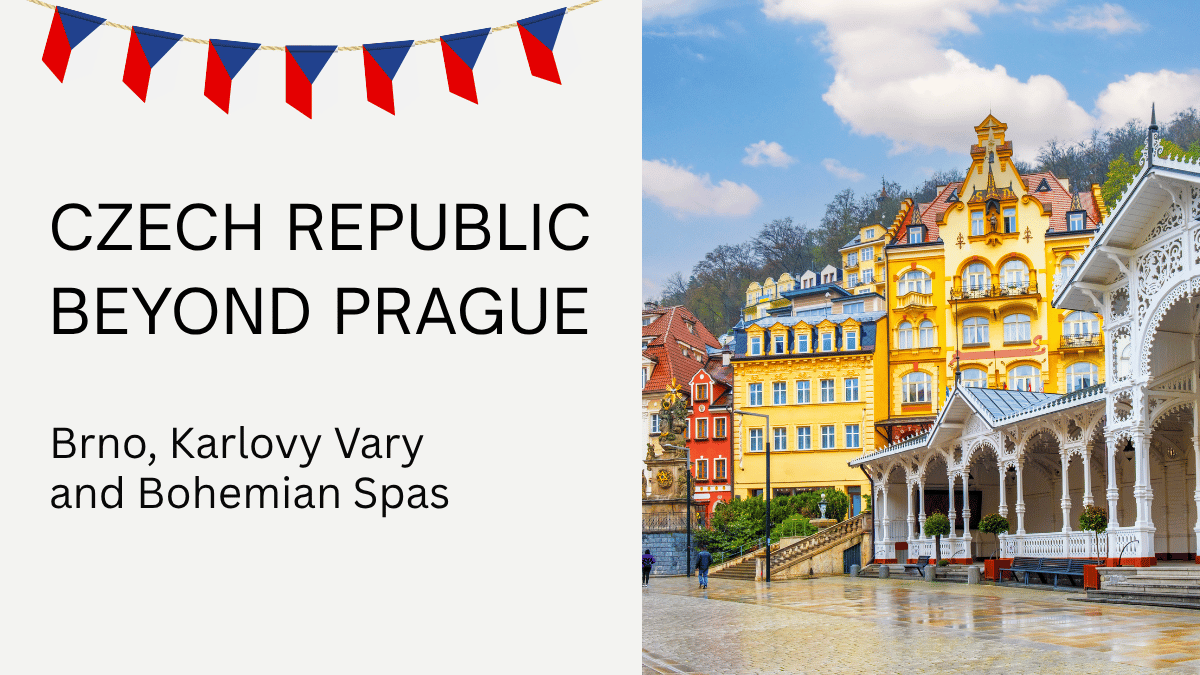
Prague may be the Czech Republic's best-known city, but it shows only one part of the country. Beyond the capital are Moravian wine towns, functionalist architecture in Brno, colonnades and mineral springs in western Bohemia, medieval centers, castle landscapes, and former industrial districts finding new uses.
A first trip beyond Prague should follow one or two regional themes rather than jumping between distant day trips. Head east to Brno and Olomouc for cities, food, and Moravian culture. Travel west to Karlovy Vary, Marianske Lazne, and Frantiskovy Lazne for the Bohemian spa triangle. Go south to Cesky Krumlov or north and east for mountain scenery and smaller historic towns.
Recommended Multi-Day Tours in the Czech Republic
Best Time to Visit Czech Republic
Late spring and early fall often bring comfortable walking weather and active cultural schedules. Summer provides long days but also stronger demand in Cesky Krumlov, Karlovy Vary, and other major destinations. Winter creates a quieter atmosphere, though some castles, gardens, caves, and outdoor attractions reduce access.
Spa towns operate year-round, but the feel changes with the season. Parks and colonnades are liveliest in warmer months, while winter favors indoor wellness and architecture. Brno, Olomouc, Plzen, and Ostrava remain viable city breaks throughout the year.
Weather in upland and mountain areas differs from conditions in Prague. Check local forecasts and current attraction calendars before committing to outdoor routes.
The Bohemian Spa Triangle
Karlovy Vary, Marianske Lazne, and Frantiskovy Lazne form the core of western Bohemia's spa region. All three are included in the transnational UNESCO World Heritage property known as the Great Spa Towns of Europe, along with spa towns in several other countries. Their shared heritage does not make them interchangeable.
Marianske Lazne: Parks and Colonnades
Marianske Lazne, historically Marienbad, spreads through a green valley with formal parks, hotels, pavilions, and spring buildings. Its atmosphere is spacious and garden-focused. The main colonnade and nearby fountains form the center of visitor activity, while walking routes extend toward forest viewpoints and surrounding countryside.
The town suits travelers who prefer landscaped parks and a quieter resort rhythm. It can be visited on a regional rail or road itinerary, but an overnight stay gives more time to enjoy the architecture without treating every spring as a checklist item.
Frantiskovy Lazne: Compact and Classical
Frantiskovy Lazne is smaller and more formally planned. Yellow and cream Neoclassical buildings, straight avenues, pavilions, and parks create a cohesive appearance. Its compact scale makes it easy to combine with nearby Cheb, whose historic center adds medieval and Baroque streets to the day.
Travelers should distinguish between visiting spa architecture and booking medical or wellness treatment. Programs, eligibility, duration, and health claims require direct confirmation with qualified providers. A casual visitor can still enjoy the parks, colonnades, cafes, and townscape without purchasing a treatment package.
How Many Spa Towns Should You Visit?
Choose Karlovy Vary if time allows only one. Add Marianske Lazne for a contrasting park-like setting, then Frantiskovy Lazne if the trip focuses specifically on European spa heritage. Visiting all three in a single hurried day reduces them to similar facades; two or three nights in western Bohemia produce a better comparison.Olomouc: Baroque Squares and a Student City
Olomouc is one of the best places to visit in the Czech Republic for travelers who want monumental architecture without Prague's scale. Its historic center contains broad squares, churches, fountains, university buildings, and the UNESCO-listed Holy Trinity Column.
The astronomical clock on the town hall has a distinctive mid-20th-century design that differs sharply from Prague's medieval spectacle. St. Wenceslas Cathedral and the Archbishop's Palace add another layer to the city's religious and political history. Olomouc's university population supports cafes, pubs, and cultural events throughout the center.
The city works as a one-night stop between Prague and destinations farther east, but two nights permit a slower visit and possible excursions. Local food includes Olomoucke tvaruzky, a strongly scented ripened cheese often served in traditional pubs.
Kutna Hora: A Strong Day Trip with Real Depth
Kutna Hora developed through medieval silver mining and once held major economic importance in the Kingdom of Bohemia. St. Barbara's Church, the Italian Court, historic streets, and mining heritage justify more than a quick stop at the Sedlec Ossuary.
The ossuary is famous for decoration made with human bones, but it remains a religious and funerary site. Visit quietly and follow current photography and entry rules. Kutna Hora is one of the easier destinations to combine with Prague by public transportation, though the principal sights are spread across more than one area.
Plzen: Brewing and Industrial Heritage
Plzen, or Pilsen, gave its name to the pilsner style of lager. Brewery visits are a central attraction, but the city also has a large main square, the Cathedral of St. Bartholomew, synagogues, museums, and industrial heritage linked to the Škoda works.
Tours, production access, and tasting conditions can change, so reserve through official channels when a brewery visit is essential. Plzen fits naturally into a western route toward the spa triangle and provides a useful contrast between industry, brewing history, and ornate resort towns.
Getting Around Czech Republic
Trains connect Prague with Brno, Olomouc, Plzen, and many regional centers. Buses are useful for destinations where rail routes are indirect, including some spa and heritage towns. Multiple operators may serve the same corridor, and tickets are not always interchangeable.
Use current operator timetables for the travel date and confirm the exact station. Prague, Brno, and other cities have multiple stops, while smaller destinations may place the bus and rail stations in different parts of town. Leave a buffer before fixed tours rather than depending on a tight connection.
A rental car is useful for South Moravian villages, the Lednice-Valtice landscape, and routes linking smaller spa towns. It is less helpful in historic centers, where parking and pedestrian zones require advance attention. Do not combine brewery or wine tastings with driving.
FAQ
What are the best places to go in Czech Republic besides Prague?
Brno is best for a substantial second city, Karlovy Vary for spa architecture, Cesky Krumlov for a compact historic setting, Olomouc for Baroque monuments, and South Moravia for wine and chateau landscapes. The right choice depends on route and interests.How many days should you spend beyond Prague?
Three days support one regional base, such as Brno or Karlovy Vary. Five days allow a focused Moravian or western Bohemian route. Eight to 10 days work for two contrasting regions without turning every day into a transfer.Is Karlovy Vary worth an overnight stay?
Yes. A day trip covers the central colonnades, but an overnight stay adds quiet mornings, forest walks, and time for wellness or nearby spa towns. Stay two nights if Karlovy Vary is the base for western Bohemia.Is Brno easy to visit without a car?
Yes. Central Brno is walkable and served by public transportation, while mainline trains connect it with Prague and Olomouc. A car becomes more useful for dispersed South Moravian villages and countryside sights.Which Czech spa town should first-time visitors choose?
Choose Karlovy Vary for the broadest range of architecture, colonnades, museums, and visitor services. Marianske Lazne favors parks and a quieter setting, while Frantiskovy Lazne is smaller and more classically planned.