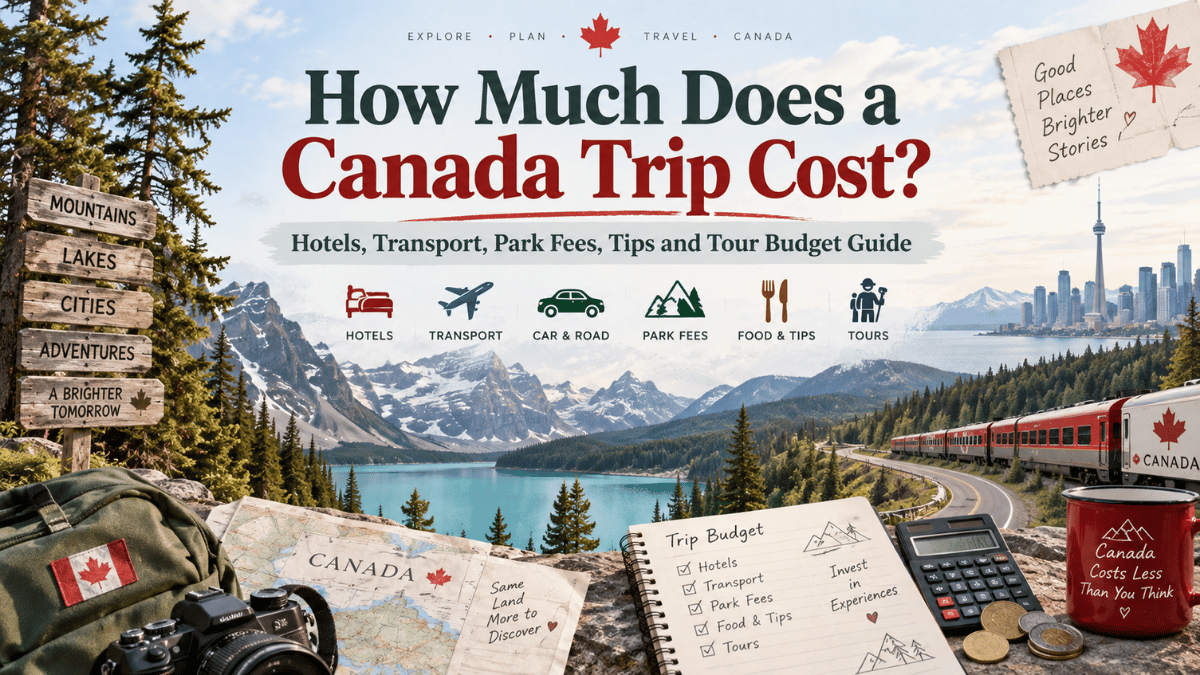
A realistic Canada trip budget is C$150-C$225 per person per day for a careful budget traveler, C$275-C$450 for a mid-range trip, and C$500 or more for a comfortable trip. These planning ranges exclude international flights and assume two people share a room; solo travelers usually pay more because accommodation is not divided. A one-week mid-range vacation therefore needs roughly C$1,925–C$3,150 per person before airfare. Toronto, Vancouver, Banff, and peak summer dates tend to push costs upward, while public transit, advance hotel reservations, and fewer intercity moves reduce them. For a multi-city or Canadian Rockies journey, compare an independent total with a guided tour after adding hotels, long-distance transport, park entry, and activities to both sides.
Canada Trip Cost at a Glance
Canada is not one price zone. A city break with transit has a different cost structure from a mountain road trip requiring a rental car and park access. Use the figures below as planning allowances in Canadian dollars, then replace them with quotes for your dates.
For two people sharing a room, a seven-day mid-range land budget is about C$3,850–C$6,300 total. Add flights, travel insurance, visa or authorization costs when applicable, and a 10%–15% contingency. The broad Canada travel collection can help you compare regions before estimating the expensive elements of a route.
| Travel Style | Hotel Share | Food | Local Transport and Activities | Daily Total Per Person |
| Budget | C$60–C$100 | C$45–C$65 | C$45–C$60 | C$150–C$225 |
| Mid-range | C$110–C$190 | C$70–C$110 | C$95–C$150 | C$275–C$450 |
| Comfortable | C$225+ | C$125+ | C$150+ | C$500+ |
For two people sharing a room, a seven-day mid-range land budget is about C$3,850–C$6,300 total. Add flights, travel insurance, visa or authorization costs when applicable, and a 10%–15% contingency. The broad Canada travel collection can help you compare regions before estimating the expensive elements of a route.
Hotel, Food, and Everyday Spending

Accommodation is usually the largest daily expense. As a working range, allow C$120–C$200 per room for simple lodging, C$220–C$380 for a well-located mid-range hotel, and C$450 or more for upscale or resort accommodation. Prices can rise sharply around summer weekends, festivals, fall foliage, and mountain resort dates. Taxes may appear late in the booking process, so budget from the final checkout total rather than the headline room rate.
Location can be worth paying for. A central hotel may remove airport parking, daily car hire, fuel, and several hours of commuting. In a transit-friendly city such as Vancouver, compare a downtown room plus transit with a cheaper suburban room plus car costs. In the Rockies, compare lodging outside a park with the fuel and time required to return each day.
Food can remain flexible. C$45–C$65 per person per day covers groceries, cafés, and casual meals with restraint; C$70–C$110 allows a mix of casual restaurants and one stronger meal. Restaurant tax and gratuity increase the amount paid beyond menu prices. Breakfast included with a room, a refillable bottle, and picnic lunches are useful savings that do not require skipping regional food entirely.
Set aside a separate allowance for attractions. Museums, observation decks, cruises, and guided activities can turn an otherwise moderate city day into an expensive one. Choose one paid priority per day and combine it with parks, neighborhoods, markets, and waterfront walks. This makes the budget predictable without reducing every decision to the cheapest option.
Transport Costs: Cities, Trains, Flights, and Cars
Urban transit is the least expensive way to explore major cities. Toronto’s standard adult pay-as-you-go fare is C$3.30 with PRESTO or contactless payment, while a PRESTO day pass is C$13.50. Travelers staying several days should compare single rides with day products instead of buying automatically. A Toronto vacation package may simplify regional sightseeing, but independent visitors should still keep local transit and airport transfers as separate budget lines.
Long-distance choices require a full-cost comparison. A low headline airfare can grow after baggage, seat selection, and airport transfers. Rail avoids some airport friction and connects selected city centers, but fares vary with route, class, and booking time. A rental car is often practical for rural or mountain areas; calculate the vehicle, insurance, fuel, parking, one-way charge, and additional-driver costs together.
For an eastern first visit, the 6-Day Toronto, Montreal, Ottawa, Quebec, and Niagara Falls tour fits travelers who want major cities and Niagara Falls connected in one organized route. It helps by consolidating several intercity movements across six days. The tradeoff is a scheduled pace, with less freedom to extend a favorite neighborhood or change the route spontaneously. Do not plan a coast-to-coast itinerary as if distances were similar to a compact European trip. Flying between eastern Canada and the West may save vacation days, while regional clusters reduce both cost and fatigue. Price one corridor first—Ontario and Quebec, Vancouver and nearby destinations, or Calgary and the Rockies—before adding another region.
Long-distance choices require a full-cost comparison. A low headline airfare can grow after baggage, seat selection, and airport transfers. Rail avoids some airport friction and connects selected city centers, but fares vary with route, class, and booking time. A rental car is often practical for rural or mountain areas; calculate the vehicle, insurance, fuel, parking, one-way charge, and additional-driver costs together.
For an eastern first visit, the 6-Day Toronto, Montreal, Ottawa, Quebec, and Niagara Falls tour fits travelers who want major cities and Niagara Falls connected in one organized route. It helps by consolidating several intercity movements across six days. The tradeoff is a scheduled pace, with less freedom to extend a favorite neighborhood or change the route spontaneously. Do not plan a coast-to-coast itinerary as if distances were similar to a compact European trip. Flying between eastern Canada and the West may save vacation days, while regional clusters reduce both cost and fatigue. Price one corridor first—Ontario and Quebec, Vancouver and nearby destinations, or Calgary and the Rockies—before adding another region.
Recommend Tour


5.0
( 18 reseñas )
Código del tour: 731883Ciudad de inicio / Ciudad de fin
Toronto
Duración
6.0 Days
Ciudad y atracciones
Toronto, Ottawa, Montreal
+21 más
Idiomas
Chinese Live, English Live
Tamaño del grupo
Máx. 13 viajeros
Audiencia del tour
Primarily Mandarin-Speaking Travelers
Ahorrar 15%
De $1,150.83
$978.21
National Park Fees and a Canadian Rockies Budget
National park admission is modest compared with mountain accommodation and transport, but it must be included. Regular Banff National Park admission as of September 8, 2026 is C$12.25 per adult per day, C$10.75 for seniors, and C$24.50 for a family or group arriving in one vehicle; youth 17 and under enter free. An annual Parks Canada Discovery Pass is C$83.50 per adult or C$167.50 per family or group. Fees can change, and camping, reservations, hot springs, permits, and guided programs are separate.
The Discovery Pass generally makes financial sense when the sum of daily admissions across participating Parks Canada locations exceeds the pass cost. Count chargeable days and eligible travelers rather than comparing trip length alone. A family arriving in one vehicle should compare the family rate, while travelers on a short visit may spend less with daily admission.
Mountain transportation often matters more than entry. Add airport-to-resort travel, a rental vehicle or shuttle, fuel, parking where applicable, and reserved lake transportation. Browse Canadian Rockies vacation packages to compare route coverage, then check whether a package replaces costs you would otherwise pay separately.
The 5-Day Canadian Rockies tour with Glacier View Lodge suits visitors who want a concentrated mountain itinerary and prefer lodging and routing to be coordinated. Its stated route includes a Glacier View Lodge stay, which can simplify a remote overnight decision. The limitation is reduced control over daily timing compared with a self-drive trip.
The Discovery Pass generally makes financial sense when the sum of daily admissions across participating Parks Canada locations exceeds the pass cost. Count chargeable days and eligible travelers rather than comparing trip length alone. A family arriving in one vehicle should compare the family rate, while travelers on a short visit may spend less with daily admission.
Mountain transportation often matters more than entry. Add airport-to-resort travel, a rental vehicle or shuttle, fuel, parking where applicable, and reserved lake transportation. Browse Canadian Rockies vacation packages to compare route coverage, then check whether a package replaces costs you would otherwise pay separately.
The 5-Day Canadian Rockies tour with Glacier View Lodge suits visitors who want a concentrated mountain itinerary and prefer lodging and routing to be coordinated. Its stated route includes a Glacier View Lodge stay, which can simplify a remote overnight decision. The limitation is reduced control over daily timing compared with a self-drive trip.
Recommend Tour

4.8
( 36 reseñas )
Código del tour: 748728Ciudad de inicio / Ciudad de fin
Calgary, Banff
Duración
5.0 Days
Ciudad y atracciones
Jasper, East Kootenay, Banff
+29 más
Idiomas
Chinese Live, English Live
Tamaño del grupo
Máx. 13 viajeros
Ahorrar $45.00
De $1,449.12
$1,404.12
How to Build and Reduce Your Canada Tour Budget
- Fix the route first. Every extra region can add a flight, a one-way vehicle fee, or a full travel day. Depth is usually cheaper than geographic breadth.
- Price the same dates. Compare an independent itinerary and an organized tour using identical nights and destinations. Include hotel taxes, transfers, admissions, and activities.
- Book scarce items early. Mountain lodging, summer weekends, and special events can become expensive. Reserve cancellable options when sensible, then review them before penalty deadlines.
- Mix spending levels. Pair a central hotel with inexpensive breakfasts, or choose simple lodging while keeping one signature activity. Spend where it changes the experience.
- Use one payment budget. Track amounts in Canadian dollars and let card statements handle conversion separately. This prevents exchange-rate mental math from hiding overspending.
- Keep a buffer. A 10%–15% contingency covers weather-related changes, extra transport, and an occasional unplanned meal or attraction.
A tour is good value when its routing replaces several large independent costs and the pace matches your preferences. It is less suitable when you want long hikes, flexible restaurant choices, or several nights in one place. Use Tours4fun to compare itinerary structure, then create a like-for-like worksheet with included and excluded items. The cheaper option is the one with the lower complete trip total, not the smallest first number shown.