Day 1: Acropolis, Museum and Plaka
One hill decides your first morning. The Acropolis sits above the city, and everything else arranges itself around it. Why go up first? Because the rest of the day falls downhill from there, and the climb is easier before the heat.
The Acropolis Before the Crowds
The climb is short and steep in places, and the stone underfoot is worn smooth, so wear something with grip. At the top is the Parthenon, and the reason to go at opening isn't the building, which isn't going anywhere, but the space around it.

Walk the whole circuit before you take a photograph. The far side looks north over the modern city and out toward the sea, and it explains Athens faster than any plaque.
If you would rather not do the climb alone, an Athens tour puts a guide beside you on the hill and at the museum, the difference between looking at a ruin and understanding what stood there.
The Acropolis Museum
Cross to the museum at the foot of the hill and give it a morning. The galleries mirror the walk up the slope, and the top floor is glass, with the hill filling the windows behind the sculptures.
Do the museum second, never first. Seeing the site gives the objects a location, and the fragments make sense once your legs remember where they came from.

Plaka and the Streets Below
Come down through Plaka, the oldest district of Athens, folded into the slope under the hill. No street here runs straight. The lanes run into each other, the stairs end at a church wall, and a wrong turn costs you a detour past a taverna with a cat on a chair.
Eat a late lunch here rather than in the squares above. Sit outside, order whatever the next table has, and let the afternoon go. Souvlaki and stuffed olive leaves are the two things to try first, and neither needs a booking.
As the light drops, walk on to the Monastiraki flea market, a permanent jumble of shops and stalls that is at its best in the early evening, once the day trippers have gone back to their hotels.
Day 2: Agora, Olympian Zeus and the Modern City
Day two stays in the city and stays low, in the order the city was built: Greek first, Roman second, modern capital last. It is the day the trip slows down, and the one where a long lunch counts as part of the plan rather than a break from it.
The Ancient Agora
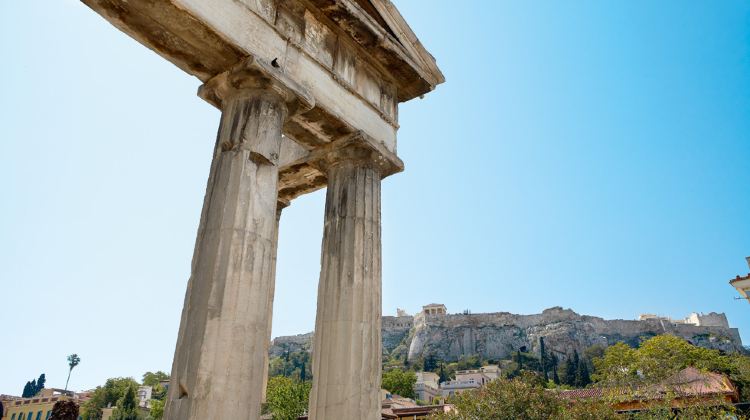
The Agora was the market and the meeting ground, the square where Athens did its business and then argued about it. It is also the stop on this route with trees and flat gravel underfoot, which makes it a friendly place to be at eleven in the morning in July.
Read the plan at the entrance before you walk in, because the ground is a scatter of foundations that mean little without a shape. One temple on the site stands almost whole, and it gives the clearest picture of what these buildings looked like before the centuries took the roofs off.
The Temple of Olympian Zeus
A few minutes east, the columns of the temple of Olympian Zeus stand in an open field with nothing to shade them. The building took so long to finish that it was out of date before it was done, and what is left is enormous. The scale is the point.

Go in the morning while the stone is still cool, or come back at the end of the day when the light comes through the columns sideways. Bring water either way, since there is no shade once you are through the gate.
Syntagma Square and Lycabettus Hill
Walk northwest into Syntagma Square, the wide open middle of modern Athens and the place the city gathers when something happens. It is the hinge between the old city and the working one, and the last flat ground before the day turns uphill.

Lycabettus Hill is the high point of the modern city, and the climb is the reward for two days of ruins: the route you have just walked sits below you, with the Acropolis lit on the other side. Go up for the last hour of light.
If rain is in the plan, the National Archaeological Museum is the indoor answer, and it holds the collection that makes sense of everything you have walked past.
Day 3: A Day on the Water, or a Slower Third Day
This is the day you leave the city. The two ways out that do not feel like a bus tour go in opposite directions, and neither fits around anything else you want to do. Water or land? Decide before you go to bed.
The Three-Island Cruise
The one-day cruise out of the port calls at three islands, and Aegina is the island the cruise listings name. That is the trip you can count on: a boat, a stretch of open water, and a stop you can walk off and back onto without arranging anything. The crossing does the work, the sea air resets two days of marble, and once you are aboard there is nothing left to organize. If the schedule offers a choice, the slow boat is the better ride and the fast one costs more.

Cape Sounion and the Other Direction
The other option is the day trip to Cape Sounion, which the Athens pages list next to Delphi as one of the two standard runs out of the city. Delphi is the archaeology day. Sounion is the one where the journey is most of the point: the edge of the land, the water below it, and a horizon with nothing on it.
Go on a clear day and go early, because weather on a headland does not care about your plan. If you fly home the next morning, take Sounion instead of the boat: you sleep in your own bed and the last evening stays in the city.
What to Cut When You Are Tired
There is a third answer, which is no plan at all: a long lunch, the market, and the hill at sunset, with nothing booked and nowhere to be. By day three most people are done with ruins, and that is fine. Cut the boat before you cut the day, because a boat keeps its own timetable and gives you no room to change your mind.
Cut Sounion on a windy day, since the point of going is to stand at the edge. Keep Plaka for the last evening, because the final night in a city should be spent eating in it rather than standing in line for a museum.
If Athens is the start of a longer trip, a Greece tour that continues to the islands makes this third day redundant, and you can spend it on the hill with a book instead.