SwitzerlandEuropePlaces to GoThings to DoTravel TipsExcursions
Mostrar todo

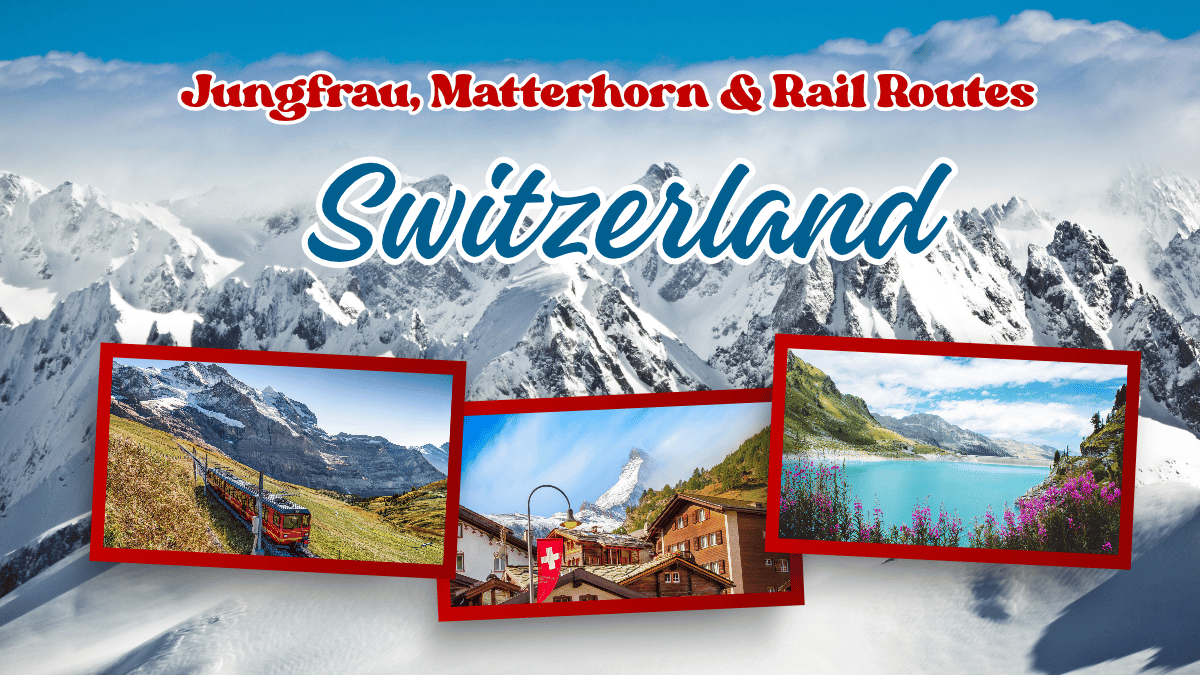
Switzerland Trip Ideas: Jungfrau, Matterhorn & Rail Routes

cover

Most Switzerland trip ideas come down to two decisions: how many days you can give the country, and whether you are here for the peaks or for the loop that links them. Five days buys you the Jungfraujoch and a morning under the Matterhorn. Ten days buys both, plus the Glacier Express, the Italian-speaking south and Lake Geneva.


The two are not interchangeable. The Jungfraujoch is a saddle of the Alps at 3,500 meters, and a train does the climbing, so it suits anyone who wants altitude without effort: there is a post office up there and the Sphinx observatory beside it. The Matterhorn is the opposite bargain. You do not stand on it; you look at it, from Zermatt's car-free streets, from the Gornergrat railway, or from the Klein Matterhorn cable car.


Both fit into one week because the trains do the driving. Two days in the Jungfrau region, two in Zermatt, and a rail day between them is a realistic five. Multi-day Switzerland tours run that loop in the other direction if you would rather not book each leg yourself.

Jungfrau Region: The Trains That Climb to the Snow


Region What it is known for Time to allow Best months
Jungfrau region Jungfraujoch, the Sphinx observatory, the 72 waterfalls of Lauterbrunnen 2–3 days June to September
Zermatt and the Matterhorn Gornergrat railway, Klein Matterhorn cable car, a village with no cars 2 days Year-round lifts; mid-June to mid-September for climbers
Lucerne and Central Switzerland Chapel Bridge, Lake Lucerne, Pilatus across the water 1–2 days Late spring to early autumn
Lake Geneva and Lavaux Chillon Castle, terraced vineyards, Montreux 2 days Late spring to early autumn


Jungfraujoch is the saddle between the Jungfrau and the Mönch, at 3,500 meters, and the railway up from Kleine Scheidegg is how you get there. That is the whole appeal: you sit down at valley level and step out into snow, with the Eiger's north wall on one side and the Aletsch glacier, the longest in Europe, spread out below. The Jungfrau itself stands at 4,158 meters, with the Eiger and the Mönch flanking the gap.


Getting up is a two-stage ride. From Interlaken Ost you take a train to Lauterbrunnen or to Grindelwald, then switch to the cogwheel train at Kleine Scheidegg. The journey takes about 2.5 hours. The other approach is the Eiger Express cable car, sold with the cogwheel train as one Jungfraujoch ticket.


Below the saddle the region earns its second reputation. Lauterbrunnen valley holds 72 waterfalls, the Trümmelbach Falls sit inside the valley, and the trail from Grindelwald to First climbs above the meadows. In winter the same slopes above Grindelwald, Mürren and Hasliberg carry skiers, and Grindelwald and Wengen fill with chalet rooms and festive markets.


Weather is the one thing you cannot plan around. Alpine conditions can change in minutes, so put the summit on your first clear morning rather than your last day, and keep the valley waterfalls as the grey-day alternative. If you would rather have the cable car, the cogwheel train and the summit handled in one go, Jungfrau tours put the pieces together.

Matterhorn and Zermatt: Seeing the Peak Without Climbing It

The Matterhorn is 4,478 meters of rock on the Italian border, in the Pennine Alps, in the canton of Valais. It was first summited in 1865, in an ascent that ended in tragedy, and it has been a symbol of alpine climbing ever since. Monte Rosa, at 4,634 meters, is the higher summit; it is not the one on the postcards.


For everyone who does not climb, the good news is that the rock is optional. Zermatt is car-free, and two railways do the work: the Gornergrat railway climbs to a ridge with the pyramid across the valley, and the Klein Matterhorn cable car goes higher still, to the Matterhorn Glacier Paradise, which runs daily from 8:30 AM to 4:30 PM, weather permitting. The platform up there is Europe's highest 360-degree viewing point.


Reaching it from the village is a three-step chain: the shuttle train or bus to the Furi-Blauherd cable car station, on line 1 or line 8, then the cable car to Blauherd, then the Hornlibahn gondola to the top. The whole run takes about 45 minutes.


Summer adds the Five Lakes Walk, which gives you the peak from five different angles, and Schwarzsee, the lake viewpoint below the north face. Neither needs a rope. Actual climbing is a separate matter: the season runs mid-June to mid-September, most attempts fall in July or August, and a certified guide is required, with self-climbing strongly discouraged.


One detail that catches people out is the border. If you ride across to Breuil-Cervinia on the Italian side, carry your passport, because the lifts cross a frontier even though both countries sit in the Schengen Area. Matterhorn tours that include the crossing will remind you, and the rest of the day is a matter of which lift you queue for.

Switzerland by Rail: Scenic Lines and Passes

A Switzerland travel guide that skips the railways misses the point of the country. The network runs 5,250 kilometers, is virtually 100% electrified, and carried 614 million passengers in 2023, which works out at 2,446 kilometers traveled per resident that year. Swiss Federal Railways operates 60% of it.


Three names do most of the scenic work. The Glacier Express links Zermatt with St. Moritz and Davos, run jointly by the Matterhorn Gotthard Bahn and the Rhaetian Railway. The Rhaetian Railway's narrow-gauge lines in Graubünden include World Heritage routes and the Landwasser viaduct on the Chur to St. Moritz run. The GoldenPass and the Glacier Express turn up on the same five-day itineraries out of Lucerne and Interlaken, which lets you collect two of them in one trip.


Under the Alps, the Gotthard Base Tunnel runs 57.1 kilometers, the longest and deepest railway tunnel in the world and the first flat, low-level route through the range. It is also the reason a train between the German-speaking north and the Italian-speaking south no longer crawls over a pass.


Tickets are where the planning gets interesting. Half-fare cards and multi-day, multi-use tickets cover buses, boats, trains and even bike rentals. Regional networks such as ZVV around Zurich and passepartout around Lucerne sell zone-based tickets, and PostAuto buses fill the valleys that never had rails. On most routes there is at least one train or bus an hour, and on many it is every 30 or even 15 minutes.


Driving is allowed and expensive. A vignette costs Fr. 40 for a year of motorway use, and speeding is treated as a serious offence rather than a small fine. Tours4fun builds rail-first itineraries, so the connections and the seat reservations stay somebody else's problem.

Best Time to Travel to Switzerland

The best time to travel to Switzerland splits into two windows, with a third option in the months between them. Which one suits you depends on whether you want snow under your boots or just under your eyes.


Spring (March–May)


Snow retreats up the valleys, meadows green over, and wildflowers arrive by May. Skiing carries on at altitude while walks open lower down in the Lauterbrunnen valley, and the crowds are thin. The trade-off is maintenance season: some mountain passes and cable cars stay shut until the snow clears.


Summer (June–August)


Long days, every lift and pass running, and the busiest weeks of the year in July and August. This is the season for the Jungfraujoch, the Five Lakes Walk and a swim in Lake Thun or Lake Brienz. Book rooms and summit slots as early as you can, because the whole country is on holiday at the same time.


Autumn (September–November)


Autumn is the driest season in Switzerland, and September keeps the lifts running while the crowds thin out. Larch trees turn gold in the Jungfrau valleys, the Jungfraujoch stays accessible, and room rates soften. November is the gamble: short days, fog on the plateau, and passes closing.


Winter (December–February)


Ski season, Christmas markets and frozen waterfalls. Days are short and resort rooms cost the most, but the Jungfraujoch keeps its glacier views year-round, and sledding and winter walking run alongside the skiing.


September is the month to pick if you want a single answer. It sits inside the dry autumn window, the summer crowds have gone home, the high lifts are still open, and the larches are turning. If your calendar is fixed instead, remember that late May to early October is the broad window for the high ground, with snow still able to close an individual pass at either end, and that July and August are its busiest weeks. Weighing the best places to travel in Switzerland against a school holiday, that difference in crowds matters more than the temperature.

Where to Stay in Switzerland

Where you sleep decides how much of each day goes to trains. Four bases cover most trips, and each one is a different kind of holiday.


Zermatt: Best for Peak Views


A car-free village at the foot of the Matterhorn, with the Gornergrat railway and the Klein Matterhorn cable car leaving from town. The glacier lifts run year-round, so this base works in any season, and the village fills early.


Interlaken: Best for Outdoor Sports


Sitting between Lake Thun and Lake Brienz, Interlaken is the outdoor and action sports capital, with skydiving, bungee jumping, rafting, canyoning and hiking on the menu. It is also the junction for Lauterbrunnen and Grindelwald, which makes it the practical base for a Jungfraujoch day.


Lucerne: Best for a First City


Chapel Bridge, the Lion Monument and the old town are walkable, Lake Lucerne is at the door, and Pilatus rises across the water. Lucerne is the main city of central Switzerland and the easiest place to pair a city morning with a mountain afternoon.


Zurich: Best for Arrivals


The largest city, with an airport that feeds straight into the rail network, so you can land and be on a train to Lucerne or Interlaken the same morning. Bahnhofstrasse handles the shopping and the lake handles the evenings.


Rates run from Fr. 350 per person per night for five stars down to Fr. 30 for a hostel bed, and the stars themselves are issued by hotelleriesuisse. Book the mountain villages before the cities; resort rooms are the priciest part of a Swiss winter trip.

Five Days or Ten? Putting a Trip Together

Two shapes do most of the work, and both assume you land in Zurich, with a seven-day version sitting between them. The difference is not pace; it is how much of the country you see from a train window.


The five-day version keeps one peak. Land in Zurich, ride to Lucerne for the Chapel Bridge and the lake, then move to Interlaken for two nights. One of those days goes to the Jungfraujoch, the other to Lauterbrunnen or the Grindelwald to First trail. The last full day is the transfer to Zermatt, an evening under the Matterhorn, and a morning on the Gornergrat before you fly home from Zurich.


Ten days lets you add the second half of the country. From Zermatt the Glacier Express runs to St. Moritz, which puts Graubünden and the Rhaetian Railway's World Heritage lines on the route. A loop back west through Lugano and Bellinzona adds the Italian-speaking south and its three castles. Lake Geneva, Chillon Castle and the Lavaux vineyards fill the last two days before a flight out of Geneva.


Three Switzerland trip ideas, in short: peaks on their own for five days, peaks plus one scenic line for seven, and the full loop for ten.


What to Keep and What to Drop

If your dates are tight, keep the Jungfraujoch and drop the Matterhorn rather than splitting four days across two valleys. The transfer between the two is the part of the trip that never feels like travel, and four days spent that way gives you two half experiences instead of one full one.


With ten days, keep both peaks and drop the lake cities, which are the easiest thing to add on a later visit. Between Lucerne and Zurich, keep Lucerne: the bridge, the lake and the mountain sit within a morning of each other, and Zurich is where you fly home from anyway.

FAQ

How many days do you need in Switzerland?

Five days covers the Jungfraujoch and a Gornergrat morning. Ten days covers both peaks, Graubünden and Lake Geneva without a rushed morning. Anything under four days means picking one region and staying in it.

Is the Jungfraujoch worth it if the summit is cloudy?

The railway runs year-round and the snow and ice are there in any season, but cloud can hide the view. On a grey morning, do the Lauterbrunnen waterfalls or the Grindelwald to First trail and move the summit to a clearer day.

Can you see the Matterhorn without climbing it?

Yes. The Gornergrat railway and the Klein Matterhorn cable car both put the peak in front of you, and Zermatt itself has clear sightlines from the river bridge. The summit alone needs a rope and a certified guide.

Do you need a car to travel around Switzerland?

No. Trains reach the cities and the mountain villages, PostAuto buses fill the gaps, and boats work the lakes. A car adds a Fr. 40 vignette and parking costs in towns without saving much time.

When is the quietest month to visit?

September. The summer crowds leave, the autumn weather is the driest of the year, and the high lifts and the Jungfraujoch are still running. November is quieter still, but fog and closed passes cut into the mountain days.

Resumen

Jungfrau Region: The Trains That Climb to the Snow

Matterhorn and Zermatt: Seeing the Peak Without Climbing It

Switzerland by Rail: Scenic Lines and Passes

Best Time to Travel to Switzerland

Where to Stay in Switzerland

Five Days or Ten? Putting a Trip Together

What to Keep and What to Drop

FAQ

America's 250th Anniversary Mega Sale

image