InnsbruckAustriaEuropePlaces to GoThings to DoTransportationTravel Tips
Mostrar todo

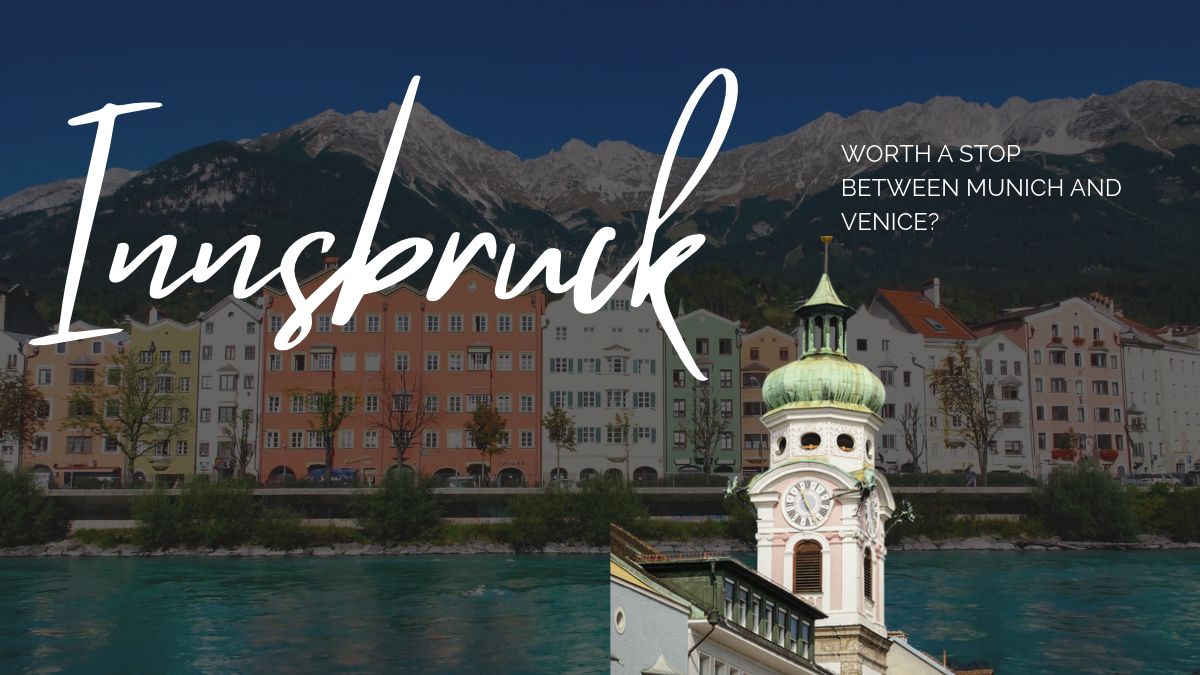
Innsbruck Tours: Worth a Stop Between Munich and Venice?

cover

Yes, Innsbruck is worth the stop, and geography makes the case. The city sits on the Inn, where the Wipp Valley runs south to the Brenner Pass, 30 km away, and that pass is how traffic gets from Bavaria into northern Italy. A Munich to Venice run goes past the exit whether you take it or not.


The cost is not distance. It is the hours you spend in town. Innsbruck tours follow two loops on this corridor: the Rome to Zurich loop gives you three hours between arrival and departure, enough for the Golden Roof, one church and a proper lunch, while the Prague loop spreads the same visit across an evening and a morning.


Two decisions shape the rest: how long you stop, and whether you go up the mountain. Get both right and three hours here beats three hours at a service station on the autobahn. Get them wrong, and you have paid for parking to look at a roof.


How Long Should You Stop in Innsbruck?

Innsbruck tours come in three lengths, and each one buys something different. The old town is compact, so the choice comes down to whether you want a mountain with your roof tiles.


An Innsbruck travel guide will point you to the Golden Roof, the Hofkirche and the Bergisel jump, and those three spread across the old town and the hill to the south. That is why a half day feels tight even when the map looks small.


Half a day: the old town on foot


Three to four hours covers the center and nothing else, which is what most people actually have. The Hauptbahnhof to the pedestrian zone is a 10 to 15 minute walk along Maria-Theresien-Strasse, and it ends within sight of the Golden Roof, so you start sightseeing the moment you leave the platform.


Count the transfer as part of the stop, because the sightseeing window is always shorter than the gap between arrival and departure. A coach has to park and walk the group in, and a car needs a space before anything else happens.


The Golden Roof is an oriel built for Emperor Maximilian I and covered in 2,657 gold-plated copper tiles. Behind it, the Hofkirche holds his tomb monument and the oversized bronze figures around it. The Hofkirche charges €3, or €1.50 reduced, and the Innsbruck Card covers it. The Cathedral of St. James on Domplatz is free to walk into.


That leaves time for lunch and a coffee on the square. What it does not leave is a mountain, a museum, or the trip out to Ambras. Half a day is the honest figure for a city stop rather than a mountain stop.


A full day: the town plus one big thing


A full day buys you exactly one addition, so pick it before you arrive. The castle or the jump, not both.


Ambras Castle opens 10:00 to 17:00, and admission follows the season at €10 from April to October and €7 from December to March. It is a Renaissance palace built in 1563 above the city, with an armoury and a portrait collection inside. Count on a half day for it.


The Bergisel ski jump is the other option: Zaha Hadid's 2001 tower on the hill south of the center, open 09:00 to 18:00, with either 450 steps or a funicular lift to the top. Both of these sit outside the old town, so a full day means choosing one and giving it a clear half.


An overnight: the evening is the payoff


The Prague loop is the one that turns this into a night. The coach reaches Innsbruck at 5:45 p.m. and walks the group down to the Golden Roof area for dinner. The next morning it leaves at 9:00 for the Swarovski Crystal Museum, comes back to the old town at 11:15, and does not pull out for Salzburg until 3:30 p.m.


That evening is the part a day trip cannot give you: dinner in the old town after the day coaches leave, and no seat to climb back into afterwards. The next day hands you the old town again at 11:15, four hours before the coach goes.


What an overnight costs you is the price of a room and one night off the road. What it buys is the ridge instead of a photo of it from the valley floor.

The Old Town and the Mountain Above It

The old town was built to show Habsburg power, and the wall above it belongs to the Karwendel Alps. That pairing is the reason the stop works.


The Golden Roof and the lanes around it


Start on Herzog-Friedrich-Strasse, where the Golden Roof overhangs the street. Maximilian I built it, moved the imperial court to Innsbruck in the 1490s, and left the city its best-known landmark.


The Altstadt around it runs Habsburg and Baroque together, with a palace and a Baroque cathedral setting the tone, and Helbling House at number 10 adding Rococo stucco to a 15th-century facade in the early 18th century. Walk south and Maria-Theresien-Strasse hands you two monuments for free: the St. Anna Column, cut from Tyrolean marble in 1706, and the Triumphal Arch from 1765.


Give the loop 90 minutes, and you will not feel rushed. The lanes are pedestrian, the distances are short, and the Hofkirche is the one stop on it with an entrance fee.


Riding up to the Nordkette


The mountain is the other half of the argument. Innsbruck hosted the Winter Olympics twice, in 1964 and 1976, and one look at the valley explains why. The city sits between ranges above 2,000 meters, and the North Chain of the Karwendel Alps rises from the rooftops to the Hafelekarspitze at 2,334 meters.


The Hungerburgbahn is the lift line that starts in town and climbs to the slopes above the city. An Innsbruck Card, sold for 24, 48 or 72 hours, includes one ascent and descent on the Nordkette, the same on Patscherkofel and Axamer Lizum, entry to the city sights and public transport.


Weather sets the schedule. Summer afternoons bring thunderstorms often enough that a morning ascent is the safer bet, and winter averages around -1°C, with snow on the peaks and Christmas markets in the streets. A clear morning is worth rearranging the day for.

The Brenner Run: Munich, Venice and Zurich

The Brenner does the work here. Innsbruck sits 30 km north of the pass, and the A13 Brennerautobahn meets the A12 Inntalautobahn in the south of town, so the crossing is the road Europe uses to get in and out of Italy.


Three legs matter if you are slotting this stop into a longer trip, and they belong to two different loops. On the Prague loop the coach leaves Munich at 3:15 p.m. and reaches Innsbruck at 5:45 p.m., 2.5 hours later. On the Rome to Zurich loop, it leaves Venice at 8:00 a.m. and reaches Innsbruck at 1:00 p.m., five hours on the road, then pulls out at 4:00 p.m. and arrives in Zurich at 7:30 p.m., which makes this the one break in a 680 km day.


Trains cover the same ground. Innsbruck Hauptbahnhof has direct services from Venice, Bolzano, Munich and Zurich, so you can build the stop into a rail trip without a car.


The Prague loop reaches Munich at 12:45 p.m. and gives you time in the historic center and lunch before the 3:15 p.m. departure, which is why the Innsbruck stop lands in the evening. A regional bus through Garmisch-Partenkirchen costs about €11 one way, and Munich airport sits 200 km away by train if you are flying out from there.


Traffic is the part nobody plans around. The Brenner fills in summer when Europe drives south to Italy and in winter when it drives to the ski hills; weekends are the worst of it, and snow makes both motorways slower still. Radio Tyrol at 96.4 FM carries the updates while you drive.


If the day carries on to Zurich, the coach crosses into Switzerland and your passport may be checked at the border, so keep it in your day bag rather than in the luggage hold.


Tours that push Munich to Venice in a single day skip the exit, and on a wet Saturday that is the right call.

When to Skip Innsbruck

Skipping is the right call more often than people expect, and the reasons are specific rather than vague.


If you are driving Munich to Venice in one day, the stop pushes your arrival back by the length of it. That settles the question when you have a check-in time or a boat to catch.


Holiday weekends on the Brenner make the same point. The pass carries Europe's summer run to Italy and its winter run to the slopes, so a Saturday in either season can turn the A13 into a slow line of cars. Move the stop to a weekday or drive through early.


Low cloud decides it too. A gray day hides the ridge, and without the mountain you are down to a roof, two churches and lunch. That is a decent half day, but it is not worth adding a night for.


Parking is the one drivers notice first. Much of downtown is a fee-based short-term parking zone, and for a longer visit the sensible move is to leave the car outside the center and take the trams. Add the search for a space and a two-hour stop starts to look thin.

Should You Sleep in Innsbruck?

Sleep here when the mountain is the point. A room turns a three-hour look into an evening and a morning, and the morning gets you onto the first lift instead of watching the ridge from the valley floor.


Sleep here as well when the driving day is long. One route into town covers 540 km from Prague with a Munich lunch stop in the middle, and Innsbruck is where that day ends. A bed beats a coach seat for the next morning.


Where the room sits matters. On the Prague loop the hotels sit out on streets like Bernhard-Hofel-Strasse and Haller Strasse, so dinner in the old town comes with a ride back. A room in the old town puts dinner and the Golden Roof on foot.


If you want the room and the sightseeing booked together, Innsbruck vacation packages pair the two, and the 24-hour Innsbruck Card covers the mountain lift, the sights and the trams on one ticket. Winter is the busiest stretch, with the Christmas markets and the start of the ski season landing in the same weeks.

Making the Call on Innsbruck

Three hours is the number to hold on to. That is what the stop costs on the Munich to Venice run, and it buys the painted roof, Maximilian's tomb in the Hofkirche, and a meal in the old town. A lot of people get off the coach, see all three, and leave satisfied.


Go longer when you want the ridge. The Nordkette needs a morning, a morning needs a bed, and that makes the overnight and the mountain the same decision rather than two.


The weather settles some of this for you. Low cloud or a Brenner traffic warning is a signal to keep driving and put the hours into Venice instead.


So keep the half day when the sky is clear and you are passing through, drop it when you are racing a flight out of Munich or a water taxi in Venice, and book the room when the ridge is the reason you took this road rather than the roof.

FAQ

Can you see Innsbruck without a car?

Yes. The main station is a short walk from the pedestrian zone, and the old town sights sit inside that walk. Trams and the S-Bahn cover anything further out.

What is the budget option from Munich?

The regional bus through Garmisch-Partenkirchen is the cheap option, and the train is faster. Check the times for your own date before you set out.

Is the Nordkette worth it on a half-day stop?

Not comfortably. The ridge is high enough that afternoon weather can close the view, so give it a morning, which usually means a night.

When is the Brenner Pass worst?

Summer weekends with traffic heading for Italy, winter weekends with traffic heading for the ski resorts, and any day with snow. Radio Tyrol at 96.4 FM carries live updates.

Do you need a passport on the way to Zurich?

Yes, carry it. It may be checked when the coach crosses into Switzerland, so keep it where you can reach it.

Resumen

How Long Should You Stop in Innsbruck?

The Old Town and the Mountain Above It

The Brenner Run: Munich, Venice and Zurich

When to Skip Innsbruck

Should You Sleep in Innsbruck?

Making the Call on Innsbruck

FAQ

America's 250th Anniversary Mega Sale

image