China Asia Autumn Places to Go Things to Do

China's Mid-Autumn Festival: Traditions & How to Celebrate

cover

Did you know there’s a festival in China dedicated to the moon? It’s not just any ordinary festival, it’s a national holiday with official time off. As autumn arrives, the air turns crisp and the leaves begin to turn golden, millions of families across China are getting ready to celebrate one of the most beautiful festivals on Earth. It’s a time for gathering, sharing food, and gazing up at the night sky. We’re talking about the Mid-Autumn Festival, a celebration that blends deep historical roots with delicious seasonal treats and dazzling light displays.

Whether you are planning a trip to China during this festive season or simply want to understand the deep cultural meaning behind those beautifully stamped pastries you see in Asian bakeries, this comprehensive guide will give you a complete picture of this magical holiday.

What Is the Mid-Autumn Festival?

Simply put, the Mid-Autumn Festival is China’s second-largest traditional festival, second only to the Spring Festival. At its heart, this holiday is all about unity and thanksgiving. Because the celebration revolves entirely around the moon at its brightest and fullest, people also frequently refer to it as the Chinese moon festival or the mooncake festival.

In Chinese culture, a full, round moon symbolizes completeness, harmony, and family reunion. No matter how far apart family members are scattered throughout the year, they make every effort to return home to sit around a shared table under the moonlight. It is a time to give thanks for the autumn harvest, pray for good fortune, and enjoy the simple pleasure of being together with the people who matter most.

Mid-Autumn Festival Lanterns

Chinese Mid-Autumn Festival Story & History


Behind this traditional festival lies a touching folk tale about Chang'e and Houyi. 

Long, long ago, earth did not have just one sun, it had ten. The intense heat scorched the crops, dried up the rivers, and pushed humanity to the brink of extinction. Seeing the suffering of the people, a heroic archer named Hou Yi stepped forward. With incredible strength and precision, he shot down nine of the ten suns, leaving just one to give light and warmth to the world.

As a reward for saving humanity, the Queen Mother of the West gave Hou Yi an elixir of immortality. A single sip of this elixir would allow a human to ascend to heaven and become a god. However, Hou Yi dearly loved his beautiful wife, Chang'e, and could not bear the thought of leaving her behind. Instead of drinking the elixir, he gave it to Chang'e to keep safe in their home.

Unfortunately, a greedy apprentice named Feng Meng found out about the secret. One day, while Hou Yi was out hunting, Feng Meng broke into the house and tried to force Chang'e to give him the elixir. Knowing she could not defeat him, Chang'e made a desperate choice. She drank the elixir herself.

Immediately, her body became weightless, and she began to float out of the window and up into the night sky. Wanting to stay as close to her beloved husband as possible, she chose to land on the moon, the closest celestial body to earth.

When Hou Yi returned and discovered what had happened, he was heartbroken. He looked up at the night sky, saw that the moon was exceptionally bright that night, and noticed a moving shadow that looked exactly like his wife. In his grief, he set up a table in the garden, laid out Chang'e’s favorite fruits and sweet cakes, and wept for his lost love. Deeply moved by this devotion, local villagers began setting up their own tables to honor Chang'e, and thus, the tradition of moon worship was born.

After Chang'e arrived on the moon, there is another story:

Chang'e isn't alone up there on the moon, though. According to legend, she shares her lunar palace with a selfless Jade Rabbit. The story goes that three deities disguised themselves as hungry old men and begged a fox, a monkey, and a rabbit for food. While the fox and monkey found food to share, the rabbit had nothing to give. Driven by compassion, the rabbit threw itself into the fire to offer its own meat. The deities were so touched by this ultimate sacrifice that they sent the rabbit to the moon, where it now accompanies Chang'e, pounding herbs in a mortar to create the elixir of life.

You might also hear about Wu Gang, a restless woodcutter who was banished to the moon for his lack of patience. His punishment? He must chop down a massive self-healing laurel tree. Every time he cuts into the trunk, the wood heals itself instantly, leaving him trapped in an eternal loop of hard labor.

Mid-Autumn Festival


Mid-Autumn Festival Traditions


The festival actually started over 3,000 years ago during the Zhou Dynasty. Ancient Chinese emperors realized that the moon directly influenced the changing seasons and the success of agriculture. To ensure a bountiful harvest the following year, rulers held formal sacrifice ceremonies to offer gifts to the moon during the autumn equinox. By the time of the Tang Dynasty (618907 AD), moon-gazing had evolved from a strict imperial ritual into a popular pastime for wealthy poets, scholars, and everyday citizens. People would gather to drink wine, play music, and write beautiful poetry dedicated to the glowing orb in the sky.

The holiday became an official statutory festival during the Song Dynasty (9601279 AD), and by the Ming and Qing Dynasties, it had grown into one of the primary celebrations in Chinese society, picking up new customs along the waylike eating the famous stamped pastries we love today.

So, what exactly do people do during this holiday? While modern life has changed how some families spend their free time, several core traditions remain absolutely non-negotiable.

Moon Gazing

This is the ultimate activity of the festival. Families clear off balconies, head to local parks, climb up hillsides, or gather by lakes to get an unobstructed view of the night sky. People set up low tables packed with snacks, tea, and seasonal fruits. It is a wonderfully slow, peaceful tradition. You sit, look up, talk about the year, and appreciate the beauty of nature.

Lighting and Hanging Lanterns

While the Spring Lantern Festival in February features massive, organized lantern displays, the mooncake festival involves a more personal, hands-on experience with light.

 
  • Children carry small, colorful paper lanterns shaped like animals, fruits, or traditional shapes through the streets.
  • Families hang beautiful red lanterns on their balconies, porches, and trees to create a warm, inviting glow.
  • In some coastal or riverside regions, people light floating water lanterns and gently push them into the current, sending their wishes downstream.
 
Solving Lantern Riddles

If you visit a public park or a historic neighborhood during the festival, you will likely see rows of colorful paper strips hanging from lanterns. Written on these strips are clever riddles. Passersby stop, read the clues, and try to guess the answers. If you solve it correctly, you can often claim a small prize from the organizers. It is a fantastic way to engage your brain and share a laugh with strangers.

Fire Dragon and Lion Dances

In certain parts of southern China, particularly Hong Kong and Guangdong province, communities organize loud, energetic fire dragon dances. Performers build massive dragon structures out of straw and rattan, stud them with thousands of glowing incense sticks, and dance through the narrow streets to the beat of heavy drums. This high-energy performance serves to drive away evil spirits, bad luck, and disease while bringing blessings to the neighborhood.


Mid-Autumn Festival Foods


Traditional Chinese festivals always feature a variety of delicious foods, and during the Mid-Autumn Festival, there is a traditional treat called mooncakes. In Chinese its called yuebing. These round pastries are typically about the size of a hockey puck, though they can vary wildly in style, filling, and texture depending on the region you visit.
 
Regional Style Crust Type Traditional Fillings Flavor Profile
Cantonese Chewy, golden, glossy, and beautifully stamped Sweet lotus seed paste, red bean paste, salted duck egg yolks Rich, sweet, and decadent
Suzhou Flaky, multi-layered, and crumbly pastry Savory minced pork, lard, sesame, or sweet osmanthus Savory or delicately sweet
Beijing Crisp, white dough with a firm texture Mountain hawthorn, date paste, nuts, and seeds Mildly sweet, traditional, and less oily
Yunnan Firm, baked wheat crust Savory Xuanwei ham, honey, and edible flower petals Perfect balance of sweet and salty

In recent years, modern variations have taken over bakery shelves. You can now easily find snow-skin mooncakes (which feature a non-baked, chewy glutinous rice crust served cold), ice cream mooncakes, chocolate fillings, and even savory versions stuffed with abalone or durian paste.

While mooncakes are enjoyed nationwide, different regions also have their own local specialties. In the Jiangsu and Zhejiang regions, for example, people eat crabs, especially hairy crabs, because they are at their most succulent in the fall. Steamed taro is another festive staple, particularly in southern China. According to local folklore, eating taro during the festival brings good luck and prosperity for the coming year.

Finally, there are foods infused with the scent of osmanthus. Autumn is the season when the delicate pale yellow osmanthus blossoms bloom across central and southern China, filling the entire city with a heavenly, sweet, apricot-like fragrance. Locals gather these flowers by hand to make stevia cakes, osmanthus honey, and smooth, sweet osmanthus wine.

When is Mid-Autumn Festival

It follows the traditional Chinese lunar calendar. The festival is always held on the 15th day of the eighth lunar month. This specific date was chosen because it marks the midpoint of autumn, ensuring that the moon will be at its fullest and brightest point of the year. Because the lunar calendar shifts slightly every year relative to our solar calendar, the western date changes annually, usually landing somewhere between mid-September and early October.

Here are the specific dates for the Mid-Autumn Festival in the coming years:
  • 2026: September 25
  • 2027: September 15
  • 2028: October 3

Traveler Tip: In mainland China, the government creates a three-day public holiday for the festival. If the festival happens to fall close to October 1st (China’s National Day), the two holidays are often combined into a single, massive 8-day holiday known as "Golden Week."

How to Celebrate the Mid-Autumn Festival

It’s easy to get into the spirit of the festival, just keep an open mind, try the local food, and check out the events.

Try some mooncakes: Sample the mooncakes available in your area, explore the variety, and pick a few different types to try. Sharing these treats with friends, hotel staff, or travel companions is a great way to spread the festive cheer. You might want to brew some tea or coffee to go with them.

Picnic: Pack a blanket, some fruit, tea, and mooncakes, and head to the nearest large park, lakeside, or riverside. These are gathering spots for the local community. You’ll see grandfathers playing traditional instruments and children running around with glowing lanterns.

Admire the lanterns: Major cities have set up large-scale public lantern displays in historic districts and commercial centers. Take an evening stroll and admire these sparkling works of art.

The Best Cities to Experience the Mid-Autumn Festival

While you can find celebrations in every single corner of China, some destinations offer jaw-dropping backdrops and unique local customs that make the holiday truly spectacular. Here are the five best places to visit during the Chinese moon festival:
 

Hangzhou


If you want to experience the poetic atmosphere and classical charm of southern China, Hangzhou is the place to go. West Lake, in particular, has been one of the best spots for moon viewing for over a thousand years.

hangzhou


The absolute best spot on the lake is an area known as "Three Pools Mirroring the Moon." Here, three small, hollow stone pagodas sit directly in the water. On the night of the festival, workers place lit candles inside each pagoda and seal the small round holes with thin paper. The light from the candles reflects on the water's surface, creating the illusion of dozens of tiny, dancing moons surrounding the real moon reflection.

Recommended Hangzhou Tour

4D3N · Private Tours · Premium Jiangnan Itinerary: Shanghai + Suzhou + Hangzhou + Wuzhen·
Guaranteed Departure
Free Cancellation
5.0
Código del tour: 754962
Ciudad de inicio / Ciudad de fin
Shanghai
Duración
4.0 Days
Ciudad y atracciones
Shanghai, Suzhou, Hangzhou +19 más
Idiomas
Chinese Live
Tipo de grupo
Other
De
$405.42

Suzhou


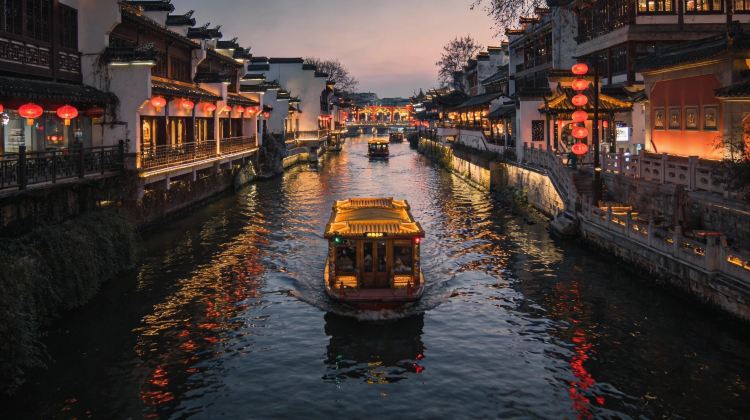
Located just a short train ride away from Shanghai, Suzhou is world-famous for its ancient water towns and classical scholar gardens. The city's narrow canals, stone humpback bridges, and white-walled traditional homes provide an incredibly atmospheric setting for autumn celebrations.

Head over to the Master of the Nets Garden or the Humble Administrator's Garden, where they often host special evening performances featuring traditional Suzhou silk embroidery displays, classical Chinese opera singing, and flute players performing on pavilions over reflective ponds. Walking through these historic gardens illuminated by soft red lanterns feels like stepping straight back into the Song Dynasty.

suzhou


Beijing


As the capital city, Beijing combines grand imperial history with massive public celebrations. For an unforgettable view, make your way to Beihai Park, a former imperial garden located right next to the Forbidden City. Locals flock here to take night cruises on the massive lake, watching the full moon rise up over the iconic White Dagoba temple.

beijing


Another phenomenal option is to climb up Jingshan Park, the hill situated directly behind the Forbidden City. From the top pavilion, you can look down at the massive palace complex stretching out beneath you, its golden roofs glowing softly under the light of the autumn moon. If you are feeling extra adventurous, you can even book an evening excursion to watch the moon rise over a rugged, illuminated section of the Great Wall.

Hong Kong


If you prefer a high-energy, vibrant urban party over quiet, classical moon-gazing, Hong Kong is the ultimate destination. The city truly comes alive during the mooncake festival.

The main highlight here is the world-famous Tai Hang Fire Dragon Dance. Located in a historic neighborhood near Causeway Bay, this tradition dates back to 1880 when local villagers successfully used a fiery dragon dance to stop a deadly plague. Today, hundreds of performers carry a massive, 67-meter-long dragon made of straw and completely covered in glowing, smoking incense sticks through the narrow streets. The smell of incense fills the air, drums beat furiously, and sparks fly into the night sky.

Additionally, Victoria Park hosts massive lantern carnivals featuring towering, modern light installations, interactive games, and traditional craft workshops.

hongkong


Taipei


In Taipei, this festival has a modern tradition: large-scale street barbecues. Local authorities set aside large public riverside parks specifically for barbecuing. Thousands of families and friends set up portable charcoal grills, cook marinated meats, seafood, and vegetables, drink ice-cold beer, and chat late into the night under the full moon. It’s a very fun, casual, and welcoming atmosphere, perfect for international travelers looking to mingle with locals.

taipei

Recommended Taipei Tour

5-Day Best of Taiwan Tour from Taipei: Sun Moon Lake, Tainan, Kaohsiung, Kenting and Hualien Adventure
Guaranteed Departure
Daily breakfast
4.8 ( 57 reseñas )
Código del tour: 689244
Ciudad de inicio / Ciudad de fin
Taipei
Duración
5.0 Days
Ciudad y atracciones
Taipei, Tainan, Kaohsiung +10 más
Idiomas
English Live, German Live, Chinese Live
Tipo de grupo
Standard Group
Ahorrar $20.00
De $790.00
$770.00

FAQ

What is a Mid-Autumn Festival in China?

It is a traditional harvest festival celebrated on the 15th day of the 8th lunar month. It focuses heavily on family reunions, moon worship, lighting colorful paper lanterns, and sharing sweet or savory stuffed pastries called mooncakes. Next to Chinese New Year, it is the most significant cultural holiday on the Chinese calendar.

How long is the Mid-Autumn holiday in China?

The official statutory public holiday typically lasts for three consecutive days. However, if the festival lands late in September or early in October, it often merges with China’s National Day holiday (October 1st), makes it an 8 day holiday.

When to avoid China in October?

You should definitely try to avoid long-distance travel within China during the first week of October (October 1st to October 7th). This is the annual National Day Golden Week. During this specific week, hundreds of millions of domestic tourists pack onto trains, flights, and highways to vacation across the country. Train tickets sell out within seconds, hotel prices skyrocket, and famous tourist sites like the Great Wall, West Lake, and terracotta warriors become incredibly crowded.