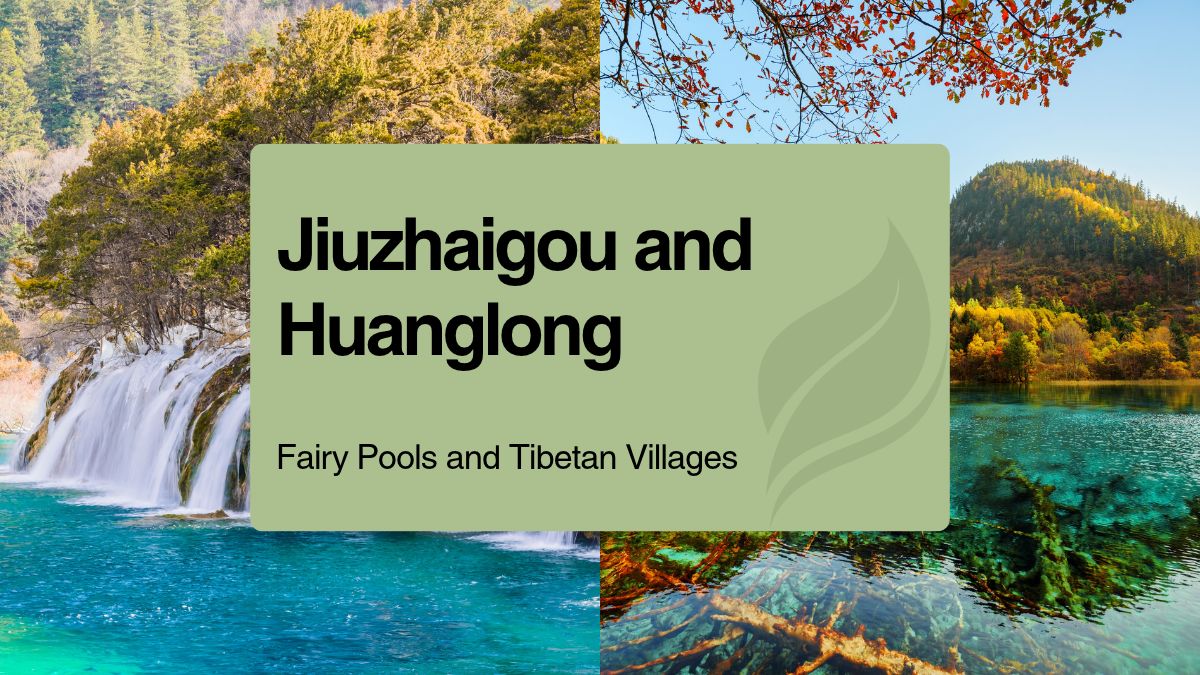
Jiuzhaigou is the reason people fly into northern Sichuan. Huanglong is the reason they add a day. The two sit a two-hour drive apart in the Min Mountains and both carry World Heritage status from 1992, yet they look nothing alike.
The difference decides how you travel. Jiuzhaigou wants a full day and rewards slow walking, with 55 kilometers of shuttle road and boardwalks that put you on the quiet side of each lake. Huanglong is a half day, and most of it sits above 3,200 meters, where the air thins and a flight of stairs gets your attention. Run the two back to back without thinking about height and the last morning turns into a headache.
A three-day Jiuzhaigou tour usually takes one of two shapes. The rail version leaves Chengdu in the morning, sleeps near the park, gives the valley its full day, then takes Huanglong on the way back to the station. The road version keeps that order and adds a panda base and Songpan on the first day, which comes to about six and a half hours behind the windshield.
Three days is enough because the geography is compact, not because the parks are small. Jiuzhaigou covers 720 square kilometers, yet the famous lakes sit between 1,980 and 3,100 meters, in a band that a shuttle bus and a set of boardwalks can cover in a day. You will not see every lake. You will see the ones people come for, with time to stand at them.
Best Jiuzhaigou & Huanglong Tours
Jiuzhaigou Valley: What the Three Valleys Look Like
Jiuzhaigou National Park is three valleys joined in a Y. Rize and Zechawa run south from a junction and merge into Shuzheng, which drains north to the gate. Buses run to the top of both southern arms, so you walk downhill from there.
The Y Shape Decides Your Day
Most visitors ride to the top of an arm and walk down, and the shuttle covers the gaps between stops. The loop is hop-on, hop-off, and the boardwalks are laid on the far side of the lakes from the road, which is why a walk between two stops feels like a different park from the bus window.
Rize Valley: The Tightest Cluster
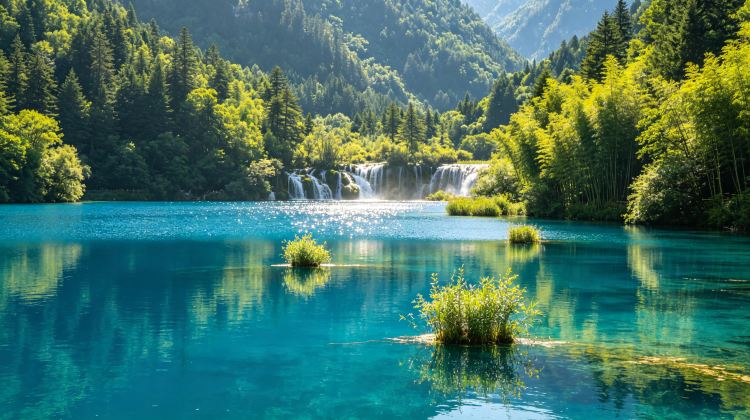
Rize is the southwestern arm, 18 kilometers long, and holds the densest run of sights. Arrow Bamboo Lake sits at 2,618 meters and was the main feature site for the 2002 film Hero. Below it, Panda Lake empties into a waterfall that drops 78 meters in three steps. Next comes Five Flower Lake, where fallen trunks lie visible underwater, then Pearl Shoal, a 310-meter curtain sliding over active limestone. In one day, most of it goes here.

Zechawa and Shuzheng: Long Lake and the Villages
Zechawa is the other southern arm and ends at Long Lake, high in the valley, with Five-Color Pond on the same arm. Shuzheng, on the way out, is where the park shows its residents, with stalls selling handicrafts, souvenirs, and snacks, and Shuzheng Waterfall on the same stretch. Save this arm for the afternoon.
Huanglong: Terraces, Altitude and Time Needed
Huanglong is one gully, and everything in it is the same material. Meltwater carries calcium carbonate down from the peaks, the mineral precipitates out of the freshwater, and the deposit builds lips of travertine that hold water in shallow steps.
What the Travertine Actually Is
The valley holds 3.6 kilometers of travertine, and the main run of water covers 2.5 kilometers of it at a width between 30 and 170 meters. The water runs yellow, green, blue, and brown, and a pool's color depends on its depth and what surrounds it. The gold tone gives the place its name, which translates as yellow dragon.

Cable Car Up, Boardwalk Down
The route most people walk runs top to bottom. Ride the cable car up, follow the boardwalk to Five-Color Pond, then walk down through the terraces to the gate. The cable car round trip is CNY 120, the park shuttle CNY 20, and an audio guide CNY 30. Five-Color Pond sits at 3,576 meters and holds 693 separate pools, with the Huanglong Ancient Temple a few minutes below at 3,568. On the way down come Golden Sand Pavement, 1,300 meters of shallow water over gold tufa, Bonsai Pond at 3,320 with its 330 pools, and the Guests Welcome Pond at 3,230.
Three Hours, and What the Height Does
Allow about three hours for the walk, and more if you stop for photographs. The route sits higher than anything in Jiuzhaigou and the top is above 3,500 meters, so walk slower than feels necessary and turn around if a headache builds. Xuebaoding, the highest peak in the Min Mountains at 5,588 meters, watches from the ridge.
Getting There from Chengdu
Chengdu is the gateway for almost everyone, and there are three ways in. Rail changed the trip most, because it removed a mountain road that used to take a day in each direction.
High-Speed Rail to Huanglong-Jiuzhaigou Station
Trains leave Chengdu East Station for a station named Huanglong-Jiuzhaigou, and the fastest cover the run in about an hour and forty minutes. From there, a bus takes roughly two hours to reach Jiuzhaigou, so the rail leg is fast and the last stretch is still mountain road. Some departures use Songpan Station instead, which puts you closer to the walled town and a shorter bus ride from the park gate.
The timetable is what makes three days work without a 5 a.m. start. Leave Chengdu mid-morning, walk a Tibetan valley in the afternoon, sleep at the park.
The Road, and the Bus Between the Parks
Long-distance buses leave Xinnanmen and Chadianzi in Chengdu, with two or three departures a day depending on demand, and the drive takes seven to eleven hours on winding roads. Heavy rain can close the road, which matters in the wet months without a booked tour. Local buses run daily to the park from Songpan and from Huanglong, so the bus from Huanglong to Jiuzhaigou works for independent travelers doing the parks in reverse order.
Flights into Jiuzhaigou Huanglong Airport
The airport sits 88 kilometers from the park, about 90 minutes by road, with flights from Chengdu on several carriers. It suits a short trip in clear weather and fails when cloud sits low.
Altitude, Weather and When to Go
Two heights explain most of the discomfort people report. Jiuzhaigou's sightseeing zone sits around 2,000 meters at the floor, and Huanglong's top pool sits at 3,576, with the terraces starting at 3,230.
Two Heights, Not One
That gap is why the order matters. A night at the valley floor gives your body a gentler introduction than driving straight up to the terraces, and doing the park first puts the harder walking day after a night at altitude.
When the Forest Turns
The valley averages 7.8°C across the year, with January at −3.7°C and July at 16.8°C. Rainfall totals 761 millimeters, 80 percent of it between May and October, so summer is green and hazy rather than sharp. Spring runs 9°C to 18°C over frozen ground and leftover snow. Summer sits at 19°C to 22°C with cool nights and rain in July and August. Autumn drops to 7°C to 18°C with clear air and a wide swing between day and night. Winter hovers near freezing.

Timed Tickets and the Daily Cap
The park enforces a ceiling of 41,000 visitors a day through timed tickets. As of November 2026, Wikipedia's entry on Jiuzhaigou records 5.11 million visitors in 2024, with over 30,000 a day in late July and early August.
Gates run from 07:00 to 19:00 from May 1 to November 15 and from 08:00 to 18:00 from November 16 to April 30. The shuttle costs CNY 90 in the peak window and CNY 80 from November 16.
Where to Sleep: Zhangzha or Songpan
Two bases, and the choice is about mornings. Zhangzha sits at the mouth of the valley, about a 12-minute drive from the gate. Songpan sits back down the road inside a walled town.
Zhangzha: Twelve Minutes From the Gate
Zhangzha grew up around the park exit and holds a dense run of hotels, including several five-star properties. On a short trip, that matters, because a short drive beats an hour of mountain road at dawn. If you would rather not run that race, Jiuzhaigou vacation packages put the room and the park days on one booking.
Songpan: Inside the Wall
Songpan has been standing for about a thousand years, and its old streets carry both Tibetan and Qiang influence. The city wall is ticketed separately from the old streets, so budget for a second entry if you want the walk along the top. It works as a first or last night, since the high-speed station sits close by and the road to Huanglong starts from there. What it does not give you is a short hop to the gate at dawn.
Tibetan Villages and What a Visit Involves
Nine villages gave Jiuzhaigou its name, and seven are still inhabited. This is not a museum arrangement. People keep houses inside a national park, and the park works around them.

Seven Villages Still Lived In
Shuzheng, Heye and Zechawa sit along the main paths and are the easiest to walk through, with stalls selling handicrafts, souvenirs and snacks. Smaller settlements sit off the shuttle loop, including Rexi in the Zaru Valley and Jianpan, Panya and Yana behind Heye. Two of the original nine, Guodu and Hejiao, are empty. In 2003, the valley held about 1,000 permanent residents in 112 families, and with farming no longer allowed inside the protected area, households earn from tourism and local government support.
What a Family Visit Looks Like
The village visits that leave an impression happen outside the gate. Zhongcha Valley, near the entrance, holds Tibetan hamlets, prayer flags, streams, forest and alpine meadow, and a gentle walk through it takes an afternoon. Dinner with a family usually means yak beef, butter tea, and tsampa in a room with a traditional fireplace, with the prayer room open to guests. Some evenings end in a Guozhuang circle dance around a fire, which is a social dance rather than a performance.
Buying Things, Not Watching a Show
Treat the stalls in Shuzheng as shops rather than exhibits, and ask before you photograph anyone. Ask your guide what a fair price looks like.
Putting the Trip Together
Strip the planning down and the trip comes to four decisions, each with a clear answer for a first visit.
Put the park before the terraces. Jiuzhaigou's main zone tops out around 3,100 meters, Huanglong's top pool sits at 3,576, and a night at 2,000 meters between them does real work. Sleeping at the gate also puts you inside before the buses from Chengdu arrive.
Then pick your road. Rail if three days is all you have and you want the mountain driving kept to the last two hours. The road if the panda base and Songpan's wall are worth six and a half hours in a seat, which for a first trip to Sichuan they often are. Flying makes sense when the forecast is clear at both ends; a cancelled landing costs you the whole first day.
Decide what to drop before what to add. With two park days, keep Rize and Zechawa and give Shuzheng the leftover hour rather than a morning. With one, keep Rize and the Long Lake arm and skip the lower villages, since the bus passes them anyway. If the height worries anyone in your group, drop Huanglong rather than pushing through, and put the saved morning into Zhongcha Valley.
Book the timed entry before the train, and the train before the room. The park caps entry at 41,000 a day, and a room at the gate is worth more than a nicer room an hour away.
FAQ
Can you see Jiuzhaigou and Huanglong in three days?
Yes, with one full day in the valley, one morning on the terraces and a transfer day at each end.Which comes first: the park or the terraces?
The park. A night near the gate at about 2,000 meters makes the climb to 3,500 the next day easier on your body.How do you travel between the two parks?
By road, roughly two hours. Buses link Huanglong and the valley daily, and guided trips include the transfer.What if someone in the group struggles with altitude?
Huanglong is the harder half, and the cable car removes most of the climb. Walk slowly at the top, watch for headache, and come down if it builds.When is the best time to go?
Late October for the color.