I've built this Chile travel itinerary around 10 days, because that is enough time to see the best of Atacama and Patagonia without spending the whole trip in transit. Below you'll find the route, how to get from Atacama to Patagonia, the best months to go, a day-by-day plan, and the booking details that most often trip up travelers.
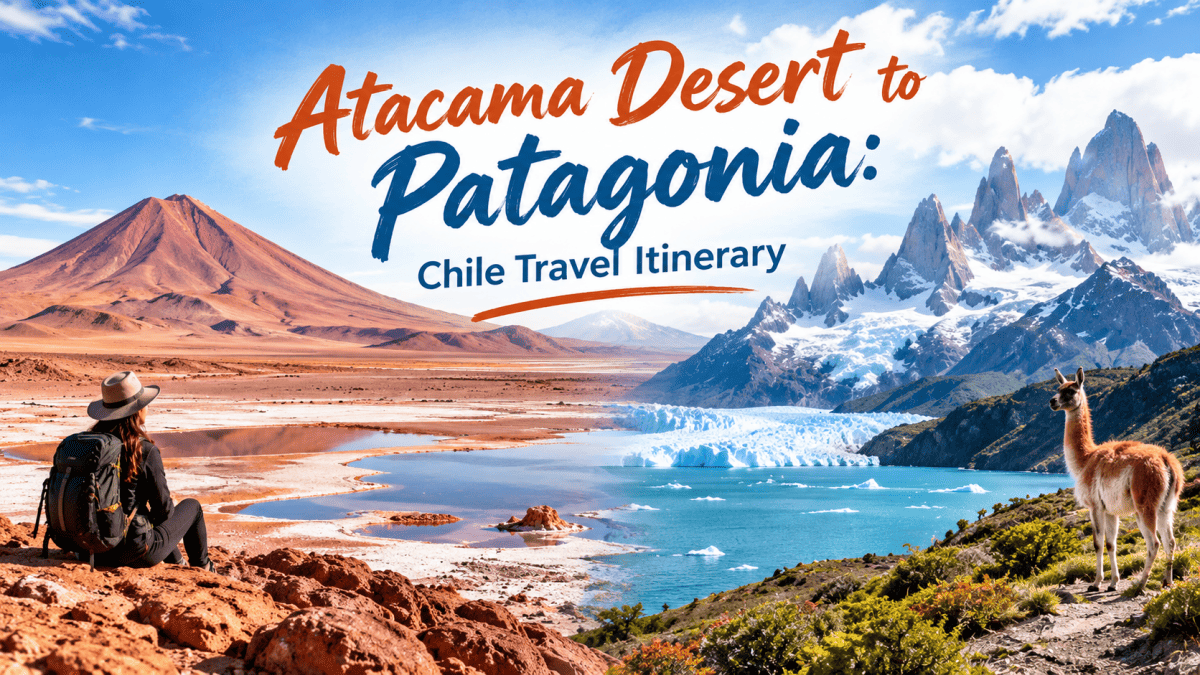
Atacama Desert to Patagonia: Chile Travel Itinerary

I've built this Chile travel itinerary around 10 days, because that is enough time to see the best of Atacama and Patagonia without spending the whole trip in transit. Below you'll find the route, how to get from Atacama to Patagonia, the best months to go, a day-by-day plan, and the booking details that most often trip up travelers.
Why Pair the Atacama Desert with Patagonia
The pairing also works for practical reasons. Both regions are built around a small base town (San Pedro de Atacama in the north, Puerto Natales in the south), both are easy to see with day trips, and both are served by regular domestic flights. You can see two of South America's best-known destinations without crossing a border.

Atacama and Patagonia
| Atacama Desert | Chilean Patagonia | |
| Base town | San Pedro de Atacama (2,438 m) | Puerto Natales |
| Gateway airport | Calama (CJC) | Punta Arenas (PUQ) |
| Headline sights | Valle de la Luna, El Tatio geysers, altiplanic lagoons, stargazing | Torres del Paine, Base Torres, Grey Glacier, Lake Pehoé |
| Landscape | Salt flats, volcanoes, dunes | Granite peaks, glaciers, lakes, steppe |
| Pace | Slow, with early starts for dawn tours | Active, with long hiking days |
| Suggested time | 4 nights | 4 nights |
How to Get from Atacama to Patagonia
| Leg | Route | Typical time |
| 1 | San Pedro de Atacama to Calama Airport (CJC) by transfer | About 1.5 hours |
| 2 | Calama to Santiago (SCL) by air | Under 2 hours |
| 3 | Santiago to Punta Arenas (PUQ) by air | About 3.5 hours |
| 4 | Punta Arenas to Puerto Natales by bus or private transfer | About 3 hours |
| 5 | Puerto Natales to Torres del Paine by bus or private transfer | About 2 hours (roughly 113 km) |
A few notes on these legs:
- Most itineraries connect through Santiago. Some flight search sites list other options between Calama and Punta Arenas, so check current schedules when you book. Either way, allow a full day for the journey.
- Fly into Punta Arenas, not Puerto Natales. Puerto Natales has a small airport, but regular flights there are rare. Punta Arenas is the practical gateway, with several non-stop Santiago flights on most days.
- Allow buffer time. Patagonian weather can delay flights. I'd avoid scheduling a tight international departure on the day you leave the park.
- Check bus timetables before you travel. Services between Puerto Natales and the park run on fixed morning and afternoon schedules and change by season. A private transfer is easier if your time is limited.
Best Time to Combine Atacama and Patagonia
| Months | Atacama | Patagonia | Verdict |
| Nov to Feb | Hot days; January and February can bring afternoon storms in the highlands | Peak season: warmest, longest days, busiest, often windy | Good for Patagonia, mixed for Atacama |
| Mar to Apr | Shoulder season, good value | Shoulder season, easier availability and often calmer weather | Best overall |
| May to Aug | Very cold nights that can drop below freezing, very clear skies | Winter; refugios close and guides are needed on high-difficulty routes | Better for Atacama only |
| Sep to Oct | Shoulder season, good value | Shoulder season | Best overall |
My recommendation is March to April or September to October. Both regions are at their most comfortable, crowds are smaller, and accommodation is easier to book. If you're set on November to February, plan Patagonia first in your mind (it has the shorter booking window) and accept that Atacama may be hot, with a chance of highland storms in January and February.
10-Day Atacama Desert to Patagonia Itinerary
Day 1: Arrive in Calama and settle into San Pedro de Atacama
Fly into Calama and transfer to San Pedro de Atacama, a small adobe town at 2,438 meters. Keep the first afternoon light. The altitude catches many travelers off guard, so drink plenty of water, walk the town's dusty streets, and save your energy for the days ahead.
Day 2: Valle de la Luna and the Salt Flats
Spend the day on the classic desert landscapes around San Pedro. Valle de la Luna is best at sunset, when the salt crusts and sand ridges turn orange and pink. If you have energy left, add a short stop at the Salar de Atacama to look for flamingos.Day 3: El Tatio Geysers at Dawn
This is the early-start day. The El Tatio geysers sit above 4,000 meters and are at their most dramatic just after sunrise, when steam rises into freezing air. Dress in layers, since mornings are bitterly cold even in warmer months. Return to town by late morning, eat a long lunch, and rest. The afternoon is yours to wander, shop, or sleep.Day 4: Altiplanic Lagoons and a Night Under the Stars
Head into the high desert to see the altiplanic lagoons, where still blue water reflects volcanoes. Tour operators generally find May through November the most reliable window for geyser and lake tours, and January and February storms can close some highland roads. Come back to San Pedro for dinner, then join a stargazing session. The desert's dry air and lack of light pollution make this one of the best places in the world to see the night sky.Day 5: Fly from Atacama to Patagonia
Transfer to Calama and take your flights through Santiago to Punta Arenas. Plan on arriving in the evening. Spend the night in Punta Arenas, a port city on the Strait of Magellan, and have dinner on the waterfront. Sleeping here splits the long journey and gives you a buffer if a flight runs late.Day 6: Punta Arenas to Puerto Natales
Take the bus or a private transfer north to Puerto Natales, which takes about three hours. This small town on the water is the most common base for visiting Torres del Paine. Use the afternoon to buy supplies, confirm your park pass, and pick up any gear you're missing.Day 7: Torres del Paine and Base Torres
Travel into the park (about two hours from Puerto Natales) and head for the Base Torres trail. The hike to the viewpoint beneath the three granite towers that give the park its name is challenging, with uneven and often exposed ground and changeable weather. Start early and bring wind and rain layers. If the trek is too much, spend the day at lower viewpoints and lake shores instead.Day 8: Grey Glacier and Lake Pehoé
Dedicate this day to the park's glacier and lake scenery. Grey Glacier is the main draw, and you can add a boat or ice-trekking excursion if you want to get closer. Lake Pehoé and the Cuernos peaks make good photo stops. Keep an eye out for guanacos along the roadsides.Day 9: Wildlife, Viewpoints and a Slower Pace
Use your last full day in the park for the things you missed. Take short walks, watch for wildlife (pumas live in the park year-round, though sightings are rare), and spend time at viewpoints with the weather in your favor. Patagonian conditions change quickly, so a flexible day like this one is worth more than a packed schedule.Day 10: Return to Punta Arenas and Fly Out
Travel back to Puerto Natales and on to Punta Arenas for your onward flight. If you have a long-haul connection afterward, book it for the following day to keep a safety margin.
Itinerary Variations
7-day version. Cut Atacama to three nights and Patagonia to three. Skip the Day 9 buffer and keep Base Torres and Grey Glacier as your two priorities.
14-day version. Add a second Atacama base or desert activity, include Santiago for two nights on the way south, and give Torres del Paine an extra day so a weather delay doesn't cost you a viewpoint.
W Trek version. The W Trek is an 80-kilometer route through the park and is commonly completed in about four days by fit hikers. It passes the main highlights, including Base Torres, and refugio beds can sell out months ahead in peak season. If you want to hike it, reserve your accommodation first and build the rest of the trip around those dates.
Practical Tips for Your Atacama and Patagonia Trip
Entry requirements
Entry rules depend on your passport, so check them with the Chilean authorities before you book. US citizens, for example, can visit for up to 90 days without a visa, and their passport needs to be valid for the length of the stay. Many airlines prefer six months of remaining validity. Keep the entry record you receive on arrival, because hotels may ask for it.Torres del Paine park pass
CONAF, Chile's national forestry service, changed the park's fee structure on May 1, 2026. The system now offers a single-day entry and a multi-day entry valid for up to 10 continuous days. Foreign visitor fees were increased as part of the change, so check the official CONAF channel (pasesparques.cl) for the current price before you budget. Hikers doing the W Trek need the multi-day pass.Altitude and sun in Atacama
San Pedro sits at 2,438 meters, and El Tatio is much higher. Take the first day slowly, stay hydrated, and use strong sun protection. Nights in the desert are cold in every season, so pack a warm layer even for summer trips.Wind and layers in Patagonia
Patagonian wind is a constant. Pack a windproof shell, a warm mid-layer, waterproof trousers, and sturdy, broken-in boots. Layers matter more than any single heavy jacket, because conditions can shift from sun to sleet in an hour.Where to stay
In San Pedro de Atacama, I'd choose a hotel within walking distance of the main street, so you can head out for dinner and stargazing pickups without a car. Many lodges in town have gardens and shaded courtyards, which are welcome after a hot day of touring. In Puerto Natales, a hotel near the waterfront makes the early bus departures and the supply shopping before the park easier. Inside Torres del Paine, lodges and refugios are limited and fill up first, so decide whether you want to sleep in the park or commute from town before you book anything else.Packing for two climates
The challenge of this trip is that you pack for desert heat and Patagonian wind in the same bag. Aim for light, breathable layers for the day in Atacama, plus a fleece and a warm hat for dawn at El Tatio and for the desert nights. For Patagonia, add a windproof and waterproof shell, gloves, and sturdy boots. Sunglasses, a high-SPF sunscreen and a refillable water bottle are useful in both places. Use a soft duffel rather than a hard case, since you'll be moving between several flights and buses.Book the long lead items first
Reserve flights, Puerto Natales accommodation, and any refugio beds early. Torres del Paine is the part of this trip most likely to sell out, particularly from November to February.Final Thoughts
A trip that crosses the full length of the country has a lot of moving parts: domestic flights, transfers, park access, and weather buffers. If you'd rather have those details handled for you, look at our Chile vacation packages to see guided options that combine northern and southern highlights.
FAQ
How long do I need for an Atacama and Patagonia trip?
Ten days is a comfortable minimum. That gives you four nights in the Atacama Desert, a travel day, and four nights in Patagonia. A shorter trip is possible, but you'll spend a bigger share of it on planes and transfers.Can I travel from the Atacama Desert to Patagonia without flying?
Not realistically. The distance is more than 3,000 kilometers, so flying is the sensible way to get from Atacama to Patagonia. Most travelers connect through Santiago and continue to Punta Arenas.Which airport should I fly into for Torres del Paine?
Punta Arenas is the practical choice, with regular nonstop flights from Santiago. From there, the bus or a private transfer takes you to Puerto Natales (about three hours) and then into the park (about two hours).Do I need to book Torres del Paine in advance?
Yes, especially for the W Trek and during peak months. Refugio beds can sell out months ahead, and the park has its own CONAF pass system. Check the official channel for current prices and rules.Is the Atacama Desert too high for most travelers?
San Pedro de Atacama is at 2,438 meters, which most healthy travelers handle with a slow first day and plenty of water. Higher excursions such as El Tatio are colder and have thinner air and less oxygen, so take them after you've adjusted. Speak to your doctor first if you have a heart or lung condition.You May Also Like

What Are the Best Waterfalls and Trails in Yosemite Valley?
20 Oct 2026

Zhangye Danxia Guide: Exploring China's Rainbow Mountains
20 Oct 2026

Argentina Travel Guide: Tango, Patagonia and Wine
20 Oct 2026
Summary
Why Pair the Atacama Desert with Patagonia
Atacama and Patagonia
How to Get from Atacama to Patagonia
Best Time to Combine Atacama and Patagonia
10-Day Atacama Desert to Patagonia Itinerary
Practical Tips for Your Atacama and Patagonia Trip
Final Thoughts
FAQ
America's 250th Anniversary Mega Sale