Zoella Last updated 14 Sep 2026
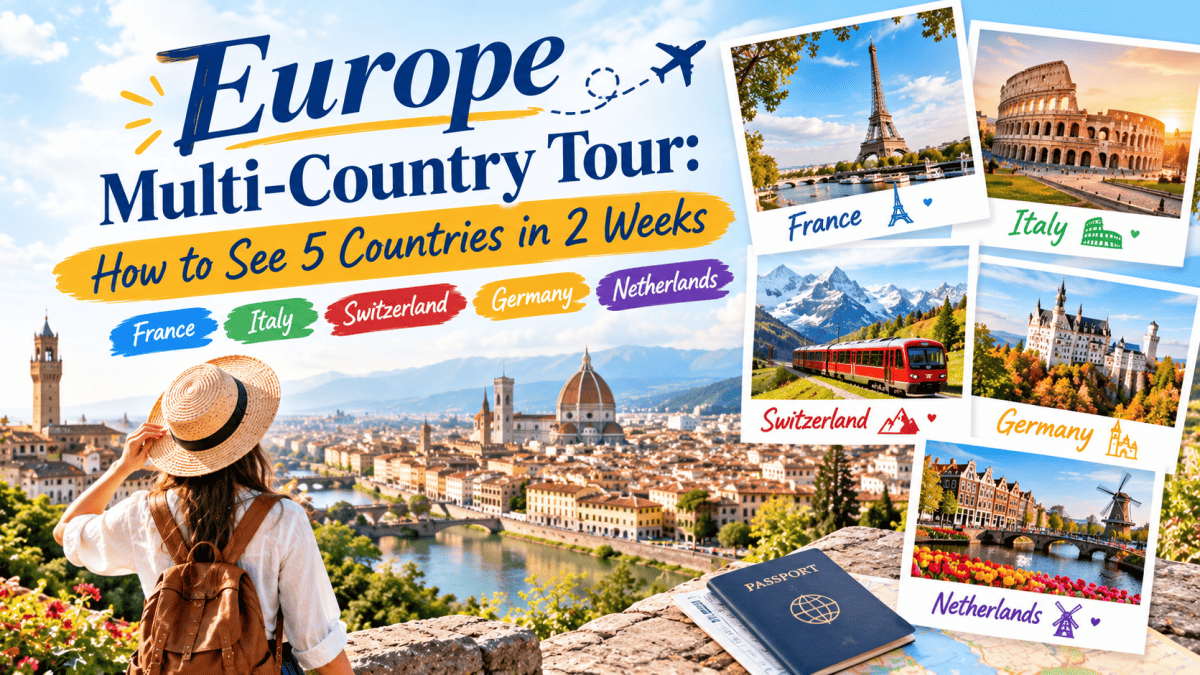
The most efficient way to see 5 European countries in 2 weeks is to follow a geographic route that minimizes backtracking and maximizes time in each destination. The classic route covers France, Switzerland, Italy, Germany, and the Netherlands (or Belgium), moving from west to east with logical train connections between each stop. Each country gets 2-3 days, which is enough time to see the major highlights without feeling rushed.
This approach works because Western and Central Europe have excellent rail connections, compact city centers, and well-established tourist infrastructure. You can explore Europe tours that follow this exact route, or browse Europe vacation packages that bundle accommodations, transportation, and guided visits into a single booking.
The Best 5-Country Route for a 2-Week Trip
Not all 5-country combinations work well in 14 days. The route below is optimized for travel time, geographic logic, and experience variety:
| Day |
Country |
City |
Key Attractions |
Travel to Next |
| 1-3 |
France |
Paris |
Eiffel Tower, Louvre, Notre-Dame, Seine cruise |
Train to Switzerland (5 hrs) |
| 4-5 |
Switzerland |
Interlaken/Lucerne |
Alps, lakes, scenic railways |
Train to Italy (3-4 hrs) |
| 6-8 |
Italy |
Rome + Florence |
Colosseum, Vatican, Uffizi, Tuscan countryside |
Flight to Germany (2 hrs) |
| 9-11 |
Germany |
Munich + Black Forest |
Neuschwanstein Castle, beer gardens, medieval towns |
Train to the Netherlands (6 hrs) |
| 12-14 |
Netherlands |
Amsterdam |
Canals, Rijksmuseum, Anne Frank House, windmills |
Depart from Amsterdam Schiphol |
This route works because it moves in a logical direction, uses fast trains for shorter distances, and includes a flight for the longest stretch (Italy to Germany). You experience five distinct cultures, cuisines, and landscapes without wasting time on unnecessary travel. Why This Route Works
Geographic Efficiency
The route follows a natural west-to-east-to-north progression through Europe. You start in Paris, swing south through Switzerland and Italy, then move north through Germany and end in Amsterdam. There is no backtracking, and each leg uses the most efficient transportation mode.
Experience Variety
Five countries in two weeks gives you remarkable variety:
- Paris offers world-class art, iconic architecture, and French cuisine
- Switzerland delivers dramatic Alpine scenery and outdoor adventure
- Italy provides ancient history, Renaissance art, and some of the world's best food
- Germany combines medieval charm, Bavarian culture, and modern energy
- The Netherlands wraps up with canal cities, cycling culture, and Dutch Golden Age art
Practical Logistics
Western and Central Europe have some of the world's best rail networks. High-speed trains connect Paris to Switzerland in 5 hours, and regional trains make the Switzerland-to-Italy leg scenic and comfortable. The one flight (Italy to Germany) covers a distance that would take too long by train, making it the smart choice for a 2-week itinerary.Day-by-Day Itinerary Breakdown
Days 1-3: Paris, France
Paris deserves at least 3 days even on a fast-paced itinerary. The city's major attractions cluster in walkable neighborhoods, and the metro system makes it easy to cover ground quickly.
Day 1: Arrive in Paris, settle into your hotel, and explore the Eiffel Tower area. Walk along the Seine, see the exterior of Notre-Dame (still under restoration), and enjoy dinner in the Latin Quarter.
Day 2: Spend the morning at the Louvre (arrive early to avoid crowds), then walk through the Tuileries Garden to the Champs-Élysées and Arc de Triomphe. In the evening, take a Seine River cruise to see the city illuminated.
Day 3: Visit Montmartre and the Sacré-Cœur basilica in the morning, then explore the Musée d'Orsay or Sainte-Chapelle in the afternoon. Leave time for café culture—sitting at a sidewalk café with a coffee and people-watching is a quintessential Paris experience.
Practical tip: The Paris Museum Pass (2, 4, or 6 days) covers most major attractions and lets you skip ticket lines. For a 3-day stay, the 4-day pass is the best value.

Days 4-5: Switzerland (Interlaken or Lucerne)
Switzerland's Alps are the highlight of this itinerary, and you need at least 2 days to experience them properly. Choose between Interlaken (more adventure-focused, between two lakes) or Lucerne (more charming town, closer to Zurich).
Day 4: Take the morning train from Paris to Interlaken or Lucerne. The journey itself is scenic, especially the Swiss portion. Arrive in the afternoon and settle in. If you choose Interlaken, take the evening boat cruise on Lake Brienz or Lake Thun.
Day 5: Take a full-day excursion into the Alps. From Interlaken, the Jungfraujoch railway takes you to the "Top of Europe" at 11,332 feet. From Lucerne, take the cogwheel railway up Mount Pilatus or Rigi. Both options offer stunning panoramic views and a genuine Alpine experience.
Practical tip: The Swiss Travel Pass covers trains, buses, and boats across the country. For a 2-day Swiss stay, the 3-day pass gives you flexibility and covers most excursions.

Days 6-8: Italy (Rome + Florence)
Italy gets 3 days on this itinerary, split between Rome (2 days) and Florence (1 day). This gives you ancient history, Renaissance art, and some of the best food in Europe.
Day 6: Take the morning train from Switzerland to Milan, then connect to Rome by high-speed train (about 3 hours from Milan). Arrive in Rome by early afternoon. Visit the Colosseum and Roman Forum in the afternoon, then explore the Trastevere neighborhood for dinner.
Day 7: Dedicate a full day to Vatican City. Arrive early for the Vatican Museums (book skip-the-line tickets in advance), see the Sistine Chapel, then visit St. Peter's Basilica. In the afternoon, explore the Pantheon, Piazza Navona, and Trevi Fountain.
Day 8: Take the morning high-speed train to Florence (1.5 hours). Spend the day at the Uffizi Gallery, see Michelangelo's David at the Accademia, and climb the Duomo. In the evening, enjoy a Tuscan dinner with bistecca alla fiorentina and Chianti wine. Return to Rome that evening or stay overnight in Florence and fly to Germany the next morning.
Practical tip: Italy's high-speed trains (Frecciarossa and Italo) are fast, comfortable, and often cheaper than flights for city-to-city travel. Book in advance for the best prices.

Days 9-11: Germany (Munich + Black Forest or Rhine Valley)
Germany offers a different flavor from the Mediterranean countries you just visited. Munich provides Bavarian culture, beer gardens, and access to fairy-tale castles.
Day 9: Fly from Rome or Florence to Munich (about 2 hours). Arrive by midday and explore Marienplatz, the New Town Hall, and the Viktualienmarkt food market. In the evening, experience a traditional Bavarian beer garden or beer hall like the Hofbräuhaus.
Day 10: Take a day trip to Neuschwanstein Castle, the fairy-tale castle that inspired Disney's Sleeping Beauty castle. The castle sits in a stunning Alpine setting, and the tour includes the ornate interior rooms. Return to Munich in the evening.
Day 11: Choose between the Black Forest (scenic drives, cuckoo clocks, hiking) or the Rhine Valley (river cruise past medieval castles). Both are accessible from Munich by train. The Rhine Valley option connects better with your next destination (Netherlands).
Practical tip: Germany's rail network (Deutsche Bahn) is efficient and covers the entire country. The German Rail Pass offers unlimited travel for a set number of days.

Days 12-14: Amsterdam, Netherlands
Amsterdam is the perfect finale to a European tour. The city is compact, bike-friendly, and packed with world-class museums and charming canals.
Day 12: Take the morning train from Germany to Amsterdam (about 6 hours from the Rhine Valley, or 3 hours if coming from the Black Forest via connections). Arrive in the afternoon and take a canal boat tour to orient yourself with the city's layout.
Day 13: Visit the Rijksmuseum to see Rembrandt's Night Watch and Vermeer's works, then walk to the Van Gogh Museum. In the afternoon, visit the Anne Frank House (book tickets well in advance—they sell out). Explore the Jordaan neighborhood for dinner.
Day 14: Spend your final morning at the Albert Cuyp market or rent a bike to explore Vondelpark. Visit a windmill (De Gooyer is the closest to the city center) before heading to Amsterdam Schiphol Airport for your departure.
Practical tip: Amsterdam's I amsterdam City Card covers public transport and free entry to many museums. For a 3-day stay, the 72-hour card offers the best value.

Transportation Between Countries
Getting between these 5 countries is straightforward thanks to Europe's excellent transportation infrastructure:
| Route |
Mode |
Duration |
Approximate Cost |
| Paris → Switzerland |
High-speed train (TGV/Lyria) |
5 hours |
$50-120 |
| Switzerland → Milan |
Regional train |
3-4 hours |
$30-60 |
| Milan → Rome |
High-speed train (Frecciarossa) |
3 hours |
$30-70 |
| Rome/Florence → Munich |
Flight |
2 hours |
$60-150 |
| Munich → Amsterdam |
Train (via Frankfurt or direct) |
6-7 hours |
$50-100 |
Rail passes vs. point-to-point tickets: For this itinerary, a Eurail Global Pass might not be the best value because you only have a few long-distance train rides. Point-to-point tickets booked in advance are often cheaper. However, if you want flexibility to make spontaneous stops, a rail pass gives you that freedom.
Budget airlines: For the Italy-to-Germany leg, budget airlines like Ryanair, easyJet, and Wizz Air offer cheap flights. Book early for the best prices, and factor in airport transfer time and baggage fees when comparing with train options. Budget Breakdown for 2 Weeks
Here's a realistic budget estimate per person for this 5-country itinerary:
| Category |
Budget Option |
Mid-Range |
Comfort |
| Accommodations (13 nights) |
$780 (hostels/budget hotels) |
$1,300 (3-star hotels) |
$2,600 (4-star hotels) |
| Transportation between countries |
$250 |
$350 |
$500 |
| Local transport (metro, buses) |
$130 |
$200 |
$250 |
| Food |
$520 ($40/day) |
$910 ($70/day) |
$1,300 ($100/day) |
| Attractions and tours |
$300 |
$500 |
$700 |
| Total per person |
$1,980 |
$3,260 |
$5,350 |
Money-saving tips:
- Book accommodations with breakfast included
- Eat lunch at local markets or bakeries instead of restaurants
- Purchase city museum passes instead of individual tickets
- Travel in shoulder season (April-May or September-October) for lower prices
- Book trains and flights 6-8 weeks in advance for the best fares
For travelers who prefer a bundled approach, Europe vacation packages can simplify budgeting by combining accommodations, transportation, and some activities into one upfront price. Best Time to Take a Multi-Country Europe Tour
Timing matters enormously for a 5-country trip. Here's when to go:
Best overall: May and September. Pleasant weather (60-75°F), smaller crowds, lower prices than peak summer. Flowers are blooming in May, and fall colors start appearing in September.
Peak season: June-August. Warmest weather, longest days, but also the most crowded and expensive. Major attractions have long lines, and popular cities feel packed. Book everything well in advance.
Shoulder season: April and October. Fewer tourists, lower prices, but some attractions may have reduced hours. Weather is cooler (50-65°F) and less predictable.
Off-season: November-March. Cheapest time to visit, but short days, cold weather, and some seasonal closures. Christmas markets in December add magic to Germany and Switzerland.
For this specific itinerary, May and September are ideal because the Alpine portions (Switzerland and Bavaria) are accessible and scenic, the cities aren't overwhelmed with tourists, and you get good value on accommodations and transportation.
Common Mistakes to Avoid
Trying to See Too Many Cities Per Country
Five countries in two weeks means you need to be strategic about which cities you visit. Stick to 1-2 cities per country maximum. Adding Venice, Barcelona, or Prague to this itinerary would mean spending more time on trains than enjoying destinations.
Underestimating Travel Time
Every time you change cities, you lose half a day to packing, checking out, traveling, and checking in. Factor this into your planning. The itinerary above accounts for this by limiting city changes to every 2-3 days.
Not Booking Key Attractions in Advance
The Vatican Museums, Anne Frank House, and Eiffel Tower all require booking and sell out weeks ahead. Book these as soon as your travel dates are confirmed.
Packing Too Much
You will be moving between cities and countries, which means carrying your luggage on and off trains, up stairs at hotels, and through cobblestone streets. Pack light—carry-on size if possible.
Ignoring the Rail Pass Math
Many travelers buy Eurail passes without calculating whether point-to-point tickets would be cheaper. For this specific itinerary, compare both options before committing. Should You Book a Guided Tour or Plan Independently?
This is one of the biggest decisions for a multi-country trip. Here's how the two approaches compare:
| Factor |
Independent Planning |
Guided Multi-Country Tour |
| Flexibility |
Complete freedom to change plans |
Fixed itinerary, some free time |
| Cost |
Can be cheaper or more expensive |
Predictable, all-inclusive pricing |
| Logistics |
You handle all bookings |
Everything arranged for you |
| Local Knowledge |
You research on your own |
Expert guide provides context |
| Social Experience |
Travel alone or with companions |
Meet fellow travelers |
| Stress Level |
Higher—many decisions to make |
Lower—everything is handled |
| Time Investment |
20-40 hours of planning |
Minimal—just show up |
For first-time visitors to Europe who want to maximize their experience without spending weeks planning, a guided multi-country tour is often the smarter choice. Tours4fun's Europe tours handle all the logistics—train tickets, hotel bookings, guided visits, and timing—so you can focus on enjoying the experience rather than managing details. With over 20 years of experience and partnerships with more than 1,000 local operators, Tours4fun has refined these multi-country itineraries based on what travelers actually want. Recommended Multi-Country Europe Tours
If you prefer a guided experience with everything handled for you, Tours4fun offers several 2-week multi-country Europe tours that cover the classic Western European route. These guided itineraries are ideal for first-time visitors who want expert local guides, pre-arranged accommodations, and seamless transportation between countries.
Best for First-Time Europe Visitors: 14-Day Europe Six-Country Tour from Paris
The Europe Six-Country Tour from Paris covers six countries in two weeks, departing from Paris and visiting France, Switzerland, Italy, Vatican City, Germany, and the Netherlands. This tour is perfect if you want to maximize your European experience and see multiple countries without the stress of planning logistics yourself. You get expert English-speaking guides, comfortable accommodations, and transportation between all destinations included in one price.
14-Day Europe Six-Country Tour from Paris
4.4
( 10 reviews )
Tour Code: 737919City & Attractions
Luxembourg, Reims, Trier
+57 more
Languages
Chinese Live, English Live
Group Size
Max. 55 travelers
Best for Paris-to-Rome Route: 14-Day West European Countries Tour
The West European Countries Tour follows a Paris-to-Rome route, covering France, Switzerland, Italy, and Germany. This tour is ideal if you want to experience the highlights of Western Europe with a focus on art, history, and Alpine scenery. The itinerary includes guided visits to major attractions, free time to explore on your own, and the convenience of having all accommodations and transportation arranged.
14-Day Western & Southern Europe from Paris
5.0
( 6 reviews )
Tour Code: 670431City & Attractions
Luxembourg, Reims, Paris
+65 more
Languages
Chinese Live, English Live
Group Size
Max. 50 travelers
Tour Audience
Primarily Mandarin-Speaking Travelers
Best for Central and Southern Europe: 14-Day Mid-South Europe Tour from Frankfurt
The Mid-South Europe Tour from Frankfurt departs from Frankfurt and covers Germany, Austria, Switzerland, Italy, and Vatican City. This tour is perfect if you want to explore Central and Southern Europe with a focus on Alpine landscapes, historic cities, and Italian culture. The tour includes scenic train rides through the Alps, guided city tours, and comfortable accommodations throughout.
14-Day All Europe Tour from Frankfurt
4.1
( 6 reviews )
Tour Code: 60970Start / End City
Frankfurt
City & Attractions
Frankfurt, Prague, Bratislava
+70 more
Languages
Chinese Live, English Live
Group Size
Max. 50 travelers
Tour Audience
Primarily Mandarin-Speaking Travelers
Final Thoughts
Seeing 5 European countries in 2 weeks is absolutely achievable with the right route and planning. The France-Switzerland-Italy-Germany-Netherlands itinerary works because it follows a logical geographic path, uses efficient transportation, and gives each country enough time to experience its highlights without feeling rushed.
The key to success is being strategic about which cities you visit, booking key attractions in advance, and packing light. Whether you plan independently or book a guided tour, the experience of moving through five distinct cultures in two weeks creates memories that last a lifetime.
FAQ
Is 2 weeks enough to see 5 European countries?
Yes, 2 weeks is enough for 5 countries if you follow a logical geographic route and spend 2-3 days per country. The key is choosing countries that are close together with good transportation connections. France, Switzerland, Italy, Germany, and the Netherlands work well because they share borders and have excellent rail links.What is the cheapest way to travel between European countries?
Trains are typically the cheapest and most convenient option for short- to medium-distance trips (under 500 miles). Budget airlines are cheaper for longer distances, but factor in airport transfer time and baggage fees. For this itinerary, trains handle most legs, with one flight from Italy to Germany.Do I need a visa for a multi-country trip in Europe?
If you are a US citizen, you don't need a visa for tourist visits to any of these 5 countries for stays of up to 90 days. All five countries are in the Schengen Area, which means one entry covers all of them. Starting in 2025, US citizens will need an ETIAS travel authorization (similar to ESTA) for visa-free travel to Schengen countries.What is the best way to handle money across 5 countries?
All five countries use the Euro except Switzerland (Swiss Franc). Use a credit card with no foreign transaction fees for most purchases, and withdraw local currency from ATMs when you need cash. Notify your bank of your travel dates before leaving to avoid card blocks.How much luggage should I bring for a 2-week multi-country trip?
Pack as light as possible—ideally a carry-on suitcase plus a daypack. You will be moving between cities frequently, and hauling large bags on trains and through train stations is exhausting. Pack versatile clothing that can be mixed and matched, and do laundry mid-trip if needed.