VancouverTorontoCanadaNorth AmericaPlaces to GoExcursionsVacations
Show All

Canada Multi-City Itinerary: How to Choose Your Route

cover

You have six days, a passport and two gateway airports to choose between. A Canada multi city itinerary rarely falls apart over the cities themselves. It falls apart when two cities four hours apart by plane are booked back to back with no room for the road between them.


There are two first trips that work. One runs from Vancouver into the Rockies and back. The other runs from Toronto through Montreal and Quebec City, with Niagara Falls on one end. Each is a closed loop, each fits inside a working week, and neither needs the other to feel finished.


So which half gets your days? Start with the season, then the gateway airport, then the nights you can spare, because reversing that order is how a trip ends up with too much road and too little time.

Why Canada Splits Into Two Trips

Two airports decide almost every route here: YVR on the Pacific and YYZ on Lake Ontario. Between them lie 8,000 km of Trans-Canada Highway and roughly a week of driving, which is why the arrival gate you book is already half the itinerary.


The 8,000 km problem in plain numbers


Set that week against a ten-day holiday and the plan falls apart. Two days in Vancouver, four days of driving, two days in the Rockies and a flight home is the coast-to-coast version. The interesting parts sit at opposite ends of the distance.


What each half actually contains


The western half is mountains and coast. Vancouver sits between the Pacific and the Coast Mountains, and the road east climbs through the Okanagan to Banff, Lake Louise and Yoho National Park. The eastern half is cities and rivers: Toronto on Lake Ontario, Niagara Falls two hours away, then Kingston, Ottawa, Montreal and Quebec City along the St. Lawrence.


Where the four-hour flight fits in


The hop between the two gateways takes over four hours in the air, and airport time at each end turns it into most of a day. A Canada tour that tries to cover both in ten days spends a full day in transit and still rushes the Rockies. With two weeks, fly between the gateways and give each half its own loop. With one week, pick a half and stay in it.

The West Line: Vancouver, the Okanagan and the Rockies

The Canada west route works as a loop out of Vancouver. You start at sea level, cross a mountain range, spend two days in the Rockies and come back through a different pass. Every stop sits on the way rather than off to the side.


Vancouver as the western base


Most trips begin at YVR. As of July 2026, the Canada Line reaches downtown in 25 minutes for $11.60, and that fare includes a $6.50 add-fare charged when you leave from the airport. A morning landing leaves the afternoon free, which is enough for the waterfront.


Banff is a 10- to 12-hour drive from Vancouver, so Vancouver works as the start and end of the loop, not as a mountain base. Calgary is the other way in, two hours from Banff, and flying there trades the long road day for a one-way car.


The Okanagan and Kalamalka Lake stopover


The first driving day runs about 316.9 miles and six hours to Salmon Arm, with a winery stop in Kelowna and a look at Kalamalka Lake along the way. Six hours in a coach moves you past the Coast Mountains before dark.


Banff, Yoho and Lake Louise on one loop


The middle day is the reason people come. It strings together Johnston Canyon, Lake Louise and the parkways through Yoho and Glacier past Rogers Pass, so you see three parks without unpacking twice. Start with the canyon; fitting three parks into one day leaves little slack.


Victoria as the island add-on


Victoria is what turns four mountain days into eight. The crossing to Vancouver Island comes on day six of the longer loop, followed by a day of about 155.3 miles and five hours. Butchart Gardens is the set piece. The two free Vancouver days at the end matter more than they look: after six early starts, a slow morning beats a fifth viewpoint.

The East Line: Toronto, Montreal, Quebec City and Niagara

The Canada east loop asks less of you behind the wheel and more of you on foot. It starts in Toronto, swings south to Niagara, then runs northeast along the St. Lawrence to Montreal and Quebec City.


Toronto and Niagara as a two-day pair


Niagara Falls is about two hours from Toronto when traffic behaves, and about 1.5 hours by car from Pearson airport. That geometry makes the falls the first or last day of the loop. GO Transit and Niagara Parks run a year-round weekend train deal that includes a two-day WEGO pass, so a car-free version exists. Give it two days: one for the falls, one for the drive back.


Kingston, Ottawa and the St. Lawrence


The coach day that links Toronto with Montreal by way of Kingston and Ottawa is one of the two long days here: about 403.9 miles and 6.8 hours, with Old Montreal and Notre-Dame Basilica before the evening. The return from Quebec City past the Thousand Islands runs about 503.3 miles and eight hours, so plan nothing afterward.


Building the corridor yourself, the train splits it neatly: Kingston to Montreal is 2.25 to 2.5 hours and Ottawa to Montreal is two hours, so one long day becomes two short ones.


Montreal and Old Quebec


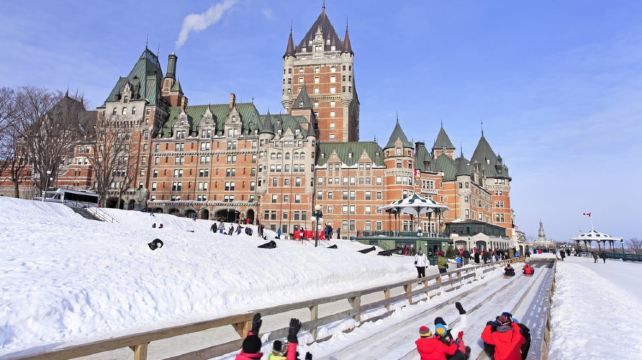
Montreal to Quebec City takes 3.25 to 3.5 hours on VIA Rail, arriving at Gare du Palais and Gare de Sainte-Foy, while Toronto to Montreal runs 5.25 hours with six trains a day. Old Quebec's cobblestone streets and French-style architecture reward an overnight rather than an afternoon. Flying Toronto to Quebec City takes 1.5 to 1.75 hours, the shortcut past the eight-hour return.

Comparing the Routes Side by Side

Put the two loops next to each other and the choice stops being about which half is nicer. A Canada itinerary that tries to cover both in a week burns a day in transit, so the question becomes where to spend the rest: in a coach watching the land change, or on a train between cities.


How to read the table


The grid lines up the two loops on what changes a booking: the airport, the stops you sleep in, the days each loop takes, the longest leg and the season window. The longest leg is the row that decides whether the trip suits your group.


Line Gateway Core stops Days Longest leg Season window
West YVR, Vancouver Vancouver, Kelowna, Salmon Arm, Banff, Lake Louise, Yoho, Victoria 4 or 8 10 to 12 hours by road July to September
East YYZ, Toronto Toronto, Niagara Falls, Kingston, Ottawa, Montreal, Quebec City 5 8 hours by coach Quebec City colors mid-September to late October


What the longest leg rules out


The west loop puts a 10- to 12-hour road day between Vancouver and Banff, and that single leg rules out a short holiday or a driver who will not sit through it. The east loop's longest day is about 503.3 miles and eight hours, long enough to want a quiet evening at the far end.


Where the extra day actually goes


On the west loop, the second day is the mountains and nothing else. The eighth day buys Victoria and two slow days in Vancouver, a different trip rather than a longer one. With five or six days and the Rockies in mind, add a night at Lake Louise or Banff instead of a second city, because the driving is already the expensive part.


On the east loop, five days covers Niagara, the St. Lawrence corridor, Montreal and Quebec City with one long coach day on each side. A sixth day belongs in Old Quebec, where an evening inside the walls beats a second afternoon at the falls.

Rail, Road or Coach: The Trade-Offs Between Cities

Between the cities you have three ways to move: train, your own car, or a coach with someone else driving. Each solves a different problem, and the answer changes with the half you picked.


VIA Rail on the Ontario-Quebec corridor


On the eastern loop, the train is the easy choice. VIA Rail runs six trains a day between Toronto and Montreal and several between Montreal and Quebec City, so a morning departure puts you in the next city by mid-afternoon.


Where rail ends and the road begins


The mountains are the exception. VIA's The Canadian reaches the Rockies by way of Edmonton or Vancouver, and the Rocky Mountaineer is a separate tourist train built around dome cars. Either way the last stretch into Banff is a road leg, so rail is the approach to the Rockies rather than the way around them.


When a coach beats both


Highways out of Vancouver cross alpine passes that avalanches and accidents can close or slow, and those closures cluster between October and May. Winter is the argument for letting someone else drive: the operator carries the road decision. Coach days on these loops run six to eight hours, with the longest at about 503.3 miles, so the trade is comfort against control.

Choosing Your Season Before You Choose Your Cities

Season decides more than which coat you pack. It decides whether the Rockies are a hiking trip or a ski trip, and whether Quebec is a city break or a color tour. Settle the window and the route settles itself.


Summer in the Rockies


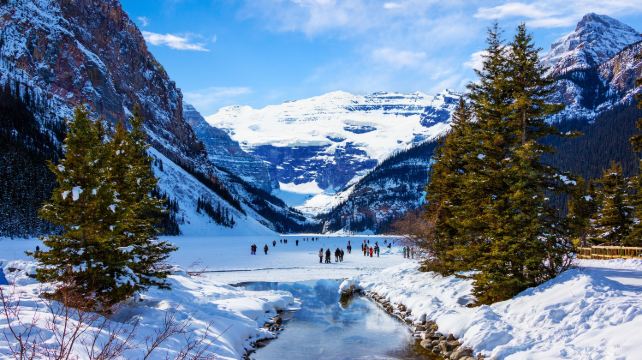
July through September is the long-daylight season in Banff and Lake Louise, when being outside from morning to night is the point. June is the shoulder month, with daytime highs of 15 to 20C and daylight stretching to nearly 17 hours. High summer runs hot and sunny at around 30C, so plan an early start and a shaded lunch.


Book the Banff nights before the flight, since the mountain beds set the dates for everything else.


The two fall windows


Autumn splits in two. Alberta's larches turn gold roughly mid-September to early October, weather-dependent, and the larch is the one conifer in Canada that changes color. Quebec's colors run mid-September to the end of October, and the provincial tourism board labels the period Peak, when 70 to 100% of leaves are most vibrant.


Those are two trips on two loops, so a single fall route cannot promise both.


Winter, and what stays open


From November through March, Banff and Lake Louise sit below freezing and the mountains run around -15C. The season suits skiing, and Mount Norquay, Sunshine Village and Ski Lake Louise stay open from November into May about 45 minutes apart. Winter sightseeing still works on the frozen lakes and snow-covered parkways, but the high alpine hiking is finished.

Building a Canada Itinerary: Days, Bases and Connections

Once the half and the season are settled, the rest is arithmetic. Count nights rather than cities, pick your base, and leave the connections to whichever mode suits the terrain.


How many days each line needs


The west loop needs four days at a minimum: a road day out to Salmon Arm, a day in the Rockies, a road day back through Kamloops, and time to reach the airport. Add four and you get Victoria plus two free Vancouver days.


The east loop runs five days and covers Niagara, Montreal, Quebec City and the St. Lawrence corridor without a wasted leg. Three days force a choice between the falls and Old Quebec. Below four days, pick one city and treat the rest as next time.


Open-jaw versus round trip


Any travel itinerary to Canada starts with the gateway, and both loops end where they began: the west in Vancouver, the east in Toronto. That makes a round-trip ticket the simple buy. An open-jaw ticket, landing in Toronto and leaving from Vancouver, earns its cost when you join the halves, and the over-four-hour flight is the entry fee.


Book a buffer night at the second airport whenever a Canada travel itinerary switches gateways, because a delayed domestic hop can cost you the long-haul seat.


If you would rather skip the driving math, Canada vacation packages bundle the hotel nights and the road legs.


Where to put the rest day


Put the rest day after the longest drive, not on arrival. On the west loop that means Vancouver after the mountains, with nothing on the calendar. On the east loop it means the morning after the Quebec City return. A rest day at the start is wasted, since you will be awake at four anyway.



The Route That Fits Your Trip

Everything above comes down to three decisions in a fixed order: which season, which gateway, how many nights. Get that order right and the rest is booking, not guessing.


A short checklist before you book


  • Pin the month first: July to September argues for the west, and Quebec City in mid-September to late October if you want color.
  • Choose the airport you can reach with one connection: YVR for the Rockies, YYZ for Ontario and Quebec.
  • Count the days you actually have: four is a west loop, five is an east loop, and under four is one city.
  • Decide whether a 10- to 12-hour drive is acceptable. If it is not, the east loop is the honest answer.


What to settle first


Settle the season and the gateway in the same sitting, because they constrain each other. A winter Rockies trip needs the Calgary or Vancouver gateway and a coach that can handle the passes, while a fall Quebec trip needs the Toronto gateway and a train seat before the colors peak. Leave the day count until last.


When the dates are already fixed


Fixed dates settle the argument faster than preference does. A holiday between November and March means frozen lakes and ski hills, so the west loop becomes a winter trip and the east loop the walking one. A date in mid-September to early October belongs to Alberta's larches, while late September into October belongs to Quebec. With one week, drop the second half rather than squeezing it in; with two, keep both and put a night at each gateway to protect the connection.

FAQ

Which loop suits a first trip, west or east?

Pick by season and by how much driving you will tolerate. If you want mountains and can give up a day to the road each way, the west loop delivers more scenery per stop. If you want cities and food with shorter hops, the east loop fits better.

Can I do the Rockies by train?

The train gets you to the mountains, and the road takes over from there. VIA's The Canadian reaches them by way of Edmonton or Vancouver, while the Rocky Mountaineer is a separate dome-car tourist train, so the last stretch into Banff is a road leg by coach or car.

How many days should I plan for?

Four days is enough for the west loop, five for the east loop, and eight adds Victoria plus two free days in Vancouver. Anything shorter than four leaves you with a single city rather than a route.

Is ten days enough for both halves?

It works if you fly between Toronto and Vancouver and accept that the flight plus airport time eats a day. Two loops of four and five days plus one travel day is tight but real.

When do the mountains and the fall colors peak?

The long-daylight window in the Rockies is July through September, Alberta's larches turn around mid-September to early October, and Quebec's colors run from mid-September to the end of October.

Summary

Why Canada Splits Into Two Trips

The West Line: Vancouver, the Okanagan and the Rockies

The East Line: Toronto, Montreal, Quebec City and Niagara

Comparing the Routes Side by Side

Rail, Road or Coach: The Trade-Offs Between Cities

Choosing Your Season Before You Choose Your Cities

Building a Canada Itinerary: Days, Bases and Connections

The Route That Fits Your Trip

FAQ

America's 250th Anniversary Mega Sale

image