The Train From Lucerne to Engelberg
Timing decides this trip more than altitude does. The Zentralbahn branch of the Swiss Federal Railways runs hourly trains between Lucerne and Engelberg through the daytime, continuing to Interlaken, and they leave from Bahnhof Luzern, the station at the point where the lake empties into the Reuss.
The Station and the Hourly Rhythm
Lucerne is easy to reach from anywhere in the country. Trains arrive half-hourly from Zurich, hourly from Zurich Airport and Olten, and there is a direct train from Bern every hour. If you are flying in, allow about two hours in total to reach Engelberg, with the change in Lucerne.
Hourly sounds generous until you miss one, and then it costs you an hour of daylight on the mountain. Treat the departure you want as a deadline rather than a target, and be standing on the platform before it leaves.

Passes, Fares and What Covers the Ride
The Engelberg line is ordinary public transport. A Swiss Travel Pass covers it, and a Saver Day Pass brings the fare down. A pass will not discount a coach-based mountain day, because those run on tour buses rather than scheduled trains. If you hold a pass, price the do-it-yourself version against the guided one before deciding the tour must cost more.
If that rhythm sounds like work, guided Mount Titlis tours hand the schedule to someone else and pick you up in the city.
Why You Check the Schedule the Night Before
The mountain keeps a maintenance calendar of its own, and routing and transport can be amended during maintenance work, so pull the current schedule the evening before instead of trusting a figure from last summer. Check two things that evening: the departure you mean to catch, and whether the cable car is running its usual route.
Engelberg to the Summit by Cable Car
The cable car begins in Engelberg at 996 m and ends at Klein Titlis at 3,028 m. That is 2,032 m of climbing in one system, and it happens in stages rather than in a single leap.
The Stages, Bottom to Top
Knowing what each stop is for saves you from getting off at the wrong one.
| Station |
Elevation |
What it does for you |
| Engelberg valley station |
996 m |
Where the Titlis Xpress starts, in the village |
| Gerschnialp |
1,262 m |
First stage of the old route, bypassed since 2016 by the direct line to Trübsee |
| Trübsee |
1,796 m |
Middle station, restaurants and the Titlis Snow Park |
| Stand |
2,428 m |
Last change before the top, on a section that runs above the glacier |
| Klein Titlis |
3,028 m |
Summit station, glacier cave entrance, shops and restaurants |
The line to Klein Titlis opened in March 1967, and it has been the main way up the mountain ever since.
Everything you came for sits at the end of the last leg. The cave entrance is inside the summit station, and so are the shops and the restaurants, which is why a cold hour up there is easier to handle than it sounds on paper.

The Rotair, and the Year It Stops Turning
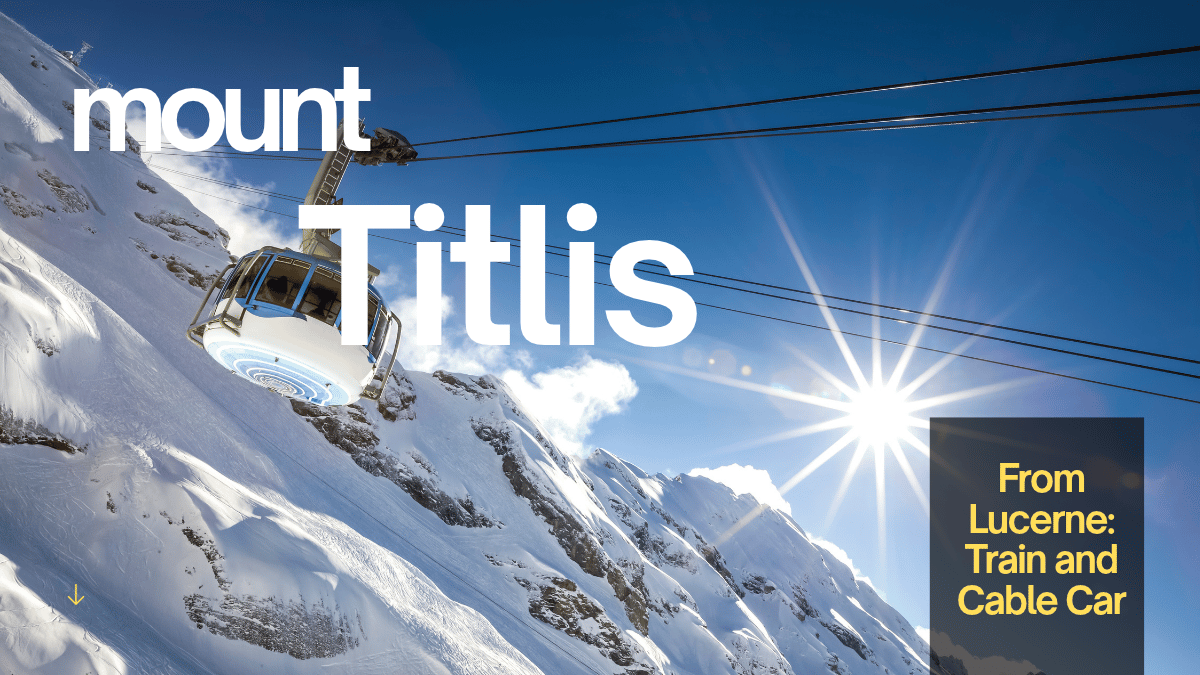
The final stretch has a reputation for a reason: Titlis runs the world's first rotating cable car, and the Rotair cabin turns through the climb so the view changes without anyone leaving a seat. In 2026, that ride has a gap in it. The Rotair is closed from 17 August to 11 December, and a non-revolving Titlis Connect car covers the same run meanwhile. Routing can change at short notice for maintenance, so confirm which car is running on your dates.
Where the Air Thins Out
Lucerne sits at 435 m by the lake, and the summit sits at 3,028 m, so the day adds 2,593 m under your boots in a single morning. The top stands above the snow line, with permanent snow cover and freezing temperatures whatever the month. A windproof jacket and shoes with rubber soles decide whether you spend an hour outside or twenty minutes of it.
Tickets: What the Day Covers and What Costs Extra
The bill on Titlis splits in two. One half is the mountain and everything on it. The other half is getting there, and that depends on which pass is already in your wallet. The ascent fare is set by the cable car operator, so price it on their site the same week you travel.
One-Day Access and What It Unlocks
A one-day access ticket for the Titlis activities is quoted at around CHF 145, and it covers the Cliff Walk, the Ice Flyer chairlift and the Glacier Cave. Buy it online rather than at the valley station window, because the queue at the base is the one thing a ticket bought in advance skips. Children often pay less, so ask when you book rather than assuming.
The TITLIS Horizon observation deck sits outside that price. It has been open since 1 June 2026 and costs CHF 18 for an adult and CHF 9 for a child, paid on the spot in cash or by card. If the summit hour is short, this is the easiest thing to drop.

Cash, Cards and the Small Print
Cards work almost everywhere in Switzerland, but mountain businesses still ask for cash in some cases, so carry a little. Meals and drinks are not part of the day ticket, and the restaurants at the summit and at Trübsee are where that bill lands.
On the Mountain: Cliff Walk, Cave, Ice Flyer, Snowtubing
Four things fill the time up there, and the day ticket covers all four.
The Cliff Walk
Europe's highest suspension bridge hangs over the glacier, and it opened in December 2012 to mark 110 years since the Engelberg to Gerschnialp cableway began running. From the deck the Alps open up in every direction, with the crevasses straight below. Cross it early in your hour if cloud is building, because the view is the entire point.
The Glacier Cave
The entrance is inside the summit station, which makes the cave the dependable stop when the weather turns. Illuminated tunnels cut through thick layers of eternal ice, and you come out by the shops and restaurants.

The Ice Flyer and the Glacier Park
The Ice Flyer chairlift takes you close to the crevasses and down to the Glacier Park, where snowtubing runs on a prepared slope. Both depend on weather and snow, so they are the first things to go when the mountain closes in.
Fitting the Four Into the Hour You Get
Construction of the new Titlis tower and summit station puts a ceiling on the visit: time at the summit is limited to roughly an hour while the work runs, then you descend to the Trübsee middle station, where the restaurants take over. Decide your hour before you arrive. Bridge, cave and one chairlift ride fit comfortably. A long lunch at 3,028 m does not.
Snow, Cloud and the Season You Pick
Snow is usually the first question a Mount Titlis travel guide has to answer, and the summit keeps it all year round. The real question up there is visibility rather than snowfall.
Winter and Early Spring
The reliable snow window runs from December to early April, and the crowds thin out midweek in January and again in late March. Christmas and Easter work the other way, so move your dates if the calendar allows it.
Summer Ice, Valley Green
June to August is the strongest stretch for glacier views and for walking, with the snow pulling back to the glacier zone while the lower slopes turn green. It is also when the summit feels less like a ski area and more like the viewpoint you came for.
When the Lifts Stop
Severe weather can close cable cars and mountain railways for safety, and no ticket changes that. Operators rework the day when it happens, and where the replacement costs less than what you paid, the difference comes back to you. If the mountain is the reason for the trip, keep a spare morning in the plan for a second attempt.
A cloudy first day is easier to absorb when you are staying in the valley instead of moving hotels, and Mount Titlis vacation packages cover the overnight side of that.
Is the Day Trip Worth It From Lucerne?
The case for going is easy to state. You keep your room in Lucerne, you stand on a 3,028 m summit, and you travel on scheduled trains rather than a coach that starts in another city. The case against is the shape of the day: departures that will not wait, an hour at the top trimmed by construction, and a mountain whose lifts can shut down in bad weather.
Many travelers treat Titlis as the cheaper and easier alternative to Jungfraujoch, and the summit is the highest point of the range north of the Susten Pass. Keep that in mind when you weigh a single day against the price of the ticket.
Two conditions tip it toward yes. The forecast has to show the summit and not just the lake, because a bright morning in Lucerne says nothing about conditions 2,593 m higher. And the day has to be genuinely free, since the transfers rather than the mountain are what fill it.
If you have two nights in Lucerne, put Titlis on the clearer day and keep the other for the old town and the waterfront, which need no ticket and no weather window. If you have a single day in the city, the arithmetic is less kind: you would trade the Chapel Bridge, a walk along the Reuss and a long lunch for a train, a cable car and an hour of snow.
That is the trade in plain terms. Keep Titlis when the sky is open and the day is yours to spend. Drop it when cloud is sitting on the ridge at breakfast and take a boat out on the lake instead, because the snow stays all year and the trains run every hour.
FAQ
Do I need to book a tour to get up the mountain?
No. The Zentralbahn line reaches Engelberg through the day and the cable car starts in the village. A tour buys the transfers and a guide, not access.Is the shortened summit hour enough to see anything?
Roughly, yes, while the tower work runs. Choose two stops rather than ticking off every one.What if the lifts are shut on my date?
The operator rearranges the day and refunds any shortfall on a cheaper substitute, so read the forecast before you commit.How much colder is the summit than Lucerne?
Lucerne can be mild while the summit sits at freezing, so take a windproof shell and grip soles.