United StatesNorth AmericaThings to DoTravel Tips
Show All

Mount Rushmore Tours: Complete Visitor Guide & History

cover

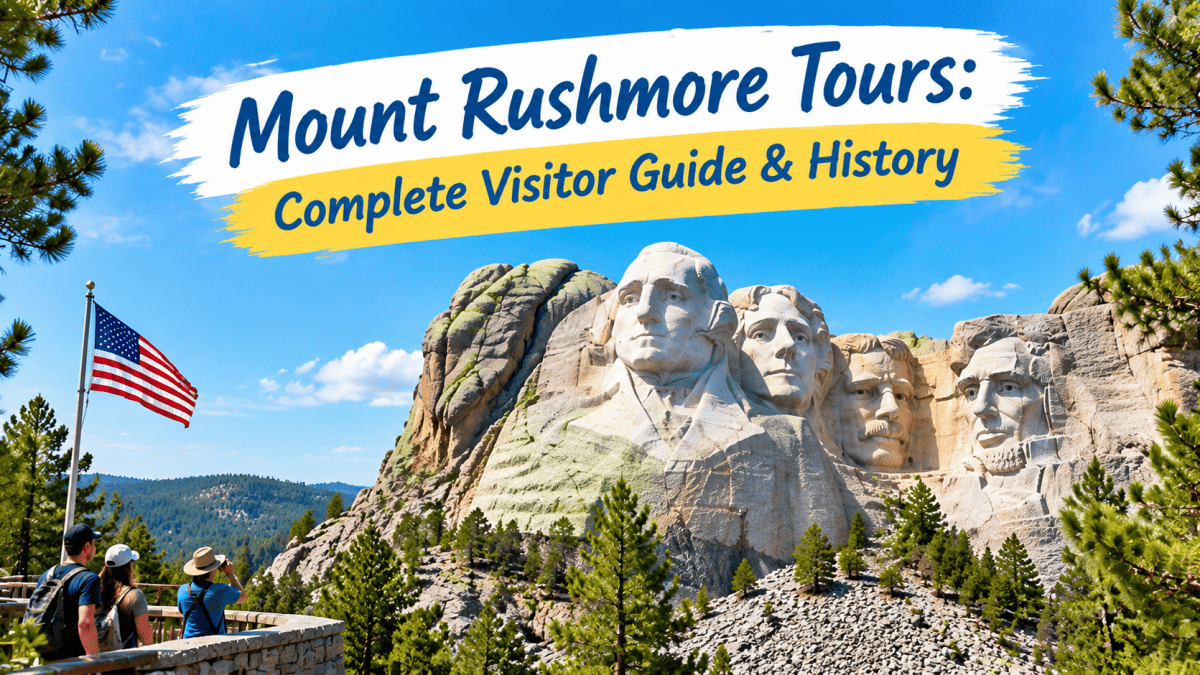
Mount Rushmore shows four faces, each about 60 feet high, looking out from a granite cliff in South Dakota's Black Hills. Most visitors expect a quick photo stop, then end up spending half a day, because the memorial sits in the middle of a region full of parks, caves, scenic drives, and wildlife.

This Mount Rushmore travel guide answers the practical questions: what it costs, when it's open, how the monument was carved, what the land meant before it was a monument, and what else is worth your time nearby.

Mount Rushmore Information

Detail Information
Location Black Hills, near Keystone, South Dakota
Entry Free. There's no entrance fee, but parking is paid
Reservations None needed to visit, including for the Evening Lighting Program
Open Year-round, seven days a week, except December 25 (buildings close that day)
Suggested time 2 to 3 hours for the promenade, exhibits and Presidential Trail
Best seasons Late spring through fall for longer days; late September to early October for mild weather

Mount Rushmore

How Mount Rushmore Tours and Visits Work

The memorial doesn't charge an entrance fee. What you pay for is parking in the concession-operated structure, and a parking ticket gives a non-commercial vehicle unlimited entry for one year from the purchase date. That means you can come back for the evening program on the same ticket.

Self-guided visits are the default. You walk the Avenue of Flags to the Grand View Terrace, take in the exhibits at the Lincoln Borglum Visitor Center, and, if you like, walk the Presidential Trail, which is 0.6 miles long with 422 steps according to one guide. Many visitors also choose guided Mount Rushmore tours that bundle the memorial with nearby sights, which saves driving on the area's winding roads. A guided tour is worth comparing if you'd rather not drive.


Parking and Costs


The NPS parking page lists these fees:
 
Vehicle Fee
Cars, motorcycles and RVs $10 per vehicle
Seniors (62+) $5
Active-duty military Free
Commercial tour buses $50, valid 24 hours
Nonprofit educational buses $25, valid 24 hours

Cash and most credit cards are accepted. Federal passes such as the America the Beautiful pass don't cover parking, and the exit kiosks take credit cards only, with no senior or military discounts. 
 

Parking Tips

 
  • The structure has six levels and four entrance gates. Lanes One to Three are for cars, trucks, and RVs under 29 feet. Lane Four handles buses, RVs over 29 feet, trailers, and commercial vehicles.
  • Parking for RVs and trailers is very limited, so arrive earlier in the day in peak summer.
  • Overnight parking isn't allowed anywhere within the memorial's boundaries.
  • Six EV charging stations are on Level Two.

Hours and the Evening Lighting Program

Visitor facilities are open year-round, seven days a week, except December 25. On that day, the parking structure and grounds may stay open, weather permitting, but all buildings close. The NPS hours page lists seasonal date ranges but not daily clock times, so call the park at 605-574-2523 or check the page before you go. All times are Mountain Time.

The sculpture is lit nightly, year-round. From late May through the end of September, a 45-minute ranger program runs nightly in the outdoor amphitheater, with a talk on the presidents, the captioned film Voices of America, and the lighting of the memorial. The page doesn't give a start time. In summer, the Sculptor's Studio hosts frequent 15-minute talks, and schedules are posted at the Information Center and the Lincoln Borglum Visitor Center.

History of Mount Rushmore

The Land Before the Monument


Early peoples were in the Black Hills by about 7000 BCE, according to the NPS. By the late 1700s, the Lakota controlled the territory, and the name Black Hills comes from the Lakota term Paha Sapa. The United States recognized the Black Hills as Lakota territory in the 1868 Treaty of Fort Laramie, but the 1874 discovery of gold brought prospectors and settlers in violation of that treaty. The Lakota and Northern Cheyenne resisted in the war of 1876, which included the Battle of Little Bighorn, and by the end of the 1800s many Lakota were forced onto reservations.

The sculptor chose a cliff the Lakota called Six Grandfathers Mountain. Many Lakota people still consider the Black Hills sacred, and the memorial remains a point of debate, so it's worth keeping that context in mind when you visit.


Carving the Memorial


South Dakota state historian Doane Robinson first proposed the idea in 1923 to promote tourism, and sculptor Gutzon Borglum led the work. Carving began in 1927. Borglum died in March 1941, and his son Lincoln Borglum oversaw the remaining work. The monument was completed on October 31, 1941. The work spanned 14 years, and the actual carving took about 6.5 years.

Workers first used dynamite to remove large sections of rock, then switched to jackhammers, chisels, and drills for precise work. The federal government paid most of the nearly $1 million cost, with private donations making up the rest.


The Four Presidents

 
President Theme
George Washington The nation's founding
Thomas Jefferson Westward expansion
Theodore Roosevelt Preservation
Abraham Lincoln The nation's development into a global power

Britannica groups these themes without tying each to a single president, so treat the pairings as the commonly cited ones.

Travel to Mount Rushmore

Most visitors reach the memorial by car, usually from Rapid City or from towns in the Black Hills such as Keystone, Hill City and Custer. A regional tourism guide describes Keystone as the closest base for early starts, Hill City or Custer as a better fit if you're pairing the visit with Custer State Park, and Rapid City as a hub for day trips. I couldn't verify current drive times or distances, so check them on the NPS directions page or a map service.

If you want to travel to Mount Rushmore without driving yourself, a guided tour is the simplest alternative. For a longer trip that adds more of the region, Mount Rushmore vacation packages cover that option.

Best Time to Visit

Season What to expect
Spring and fall Mild temperatures and fewer crowds. One guide recommends late September to early October for mild weather, low rain chances and fall colors
Summer The busiest and hottest season, with possible hailstorms. The nightly ranger program runs only in summer
Winter The quietest and coldest season, with possible snow. The sculpture is still lit nightly

Mornings are quieter, and crowds peak at midday, especially on weekends. If you visit in the day and return in the evening, keep your parking ticket, since it covers a second visit.

Things to Do Around Mount Rushmore

These are the things to do around Mount Rushmore that I'd put on a first list. Driving times come from a regional guide and are approximate.
 
Stop Distance Notes
Crazy Horse Memorial About 15 minutes A mountain carving in progress, viewed from a distance unless you pay extra for a bus to the base. The Indian Museum of North America is on site
Custer State Park Wildlife Loop About 20 minutes An 18-mile loop with bison, pronghorn and elk. A park entrance fee applies. Dawn and dusk are best, and keep your distance from bison
Sylvan Lake About 20 minutes Inside Custer State Park. Kayak and paddleboard rentals, and an easy mile-long shoreline loop. Crowded on summer afternoons
Black Elk Peak About 25 minutes A 7.1-mile round-trip hike of 3 to 4 hours. Bring water and start early in summer
Jewel Cave National Monument About 35 minutes Tours carry a fee. The Scenic Tour involves over 700 stairs, so book ahead in summer
Wind Cave National Park About 50 minutes Entry is free. Cave access is ranger-led only and has been limited in some recent seasons, so confirm tours
Badlands National Park About 1 hour 15 minutes Sunrise and sunset give the best light
Iron Mountain Road About an hour to drive A 17-mile route with one-lane tunnels. Take it slowly

A combined day is easy: Mount Rushmore in the morning, then Crazy Horse and the Custer State Park wildlife loop in the afternoon, with the evening lighting to finish if it's summer.

Final Thoughts

Mount Rushmore is quick to see and easy to extend. Park once, go in the morning, come back for the lighting if you're there in summer, and spend the rest of the day on the Black Hills' wildlife loop, lakes and caves. Check the hours and the parking fee before you go, since both can change.

FAQ

Is there an entrance fee for Mount Rushmore?

No. Entry is free, but you pay to park in the concession-operated structure. The NPS parking page lists $10 per vehicle, with $5 for seniors and free parking for active-duty military.

Do I need a reservation to visit Mount Rushmore?

No. Reservations aren't needed to visit or for any programs, including the Evening Lighting Program.

How long do you need at Mount Rushmore?

A regional guide suggests 2 to 3 hours for the promenade, exhibits, and Presidential Trail. Another says 1 to 2 hours, and a quick stop can take about 30 minutes.

Is Mount Rushmore lit at night?

Yes. The sculpture is illuminated nightly, year-round. A 45-minute ranger program runs nightly from late May through September.

Are Mount Rushmore tours worth it?

They can be, if you want to see several Black Hills sights without driving yourself. If you prefer to go at your own pace, a self-guided visit works well.

Summary

Mount Rushmore Information

How Mount Rushmore Tours and Visits Work

Hours and the Evening Lighting Program

History of Mount Rushmore

Travel to Mount Rushmore

Best Time to Visit

Things to Do Around Mount Rushmore

Final Thoughts

FAQ

America's 250th Anniversary Mega Sale

image