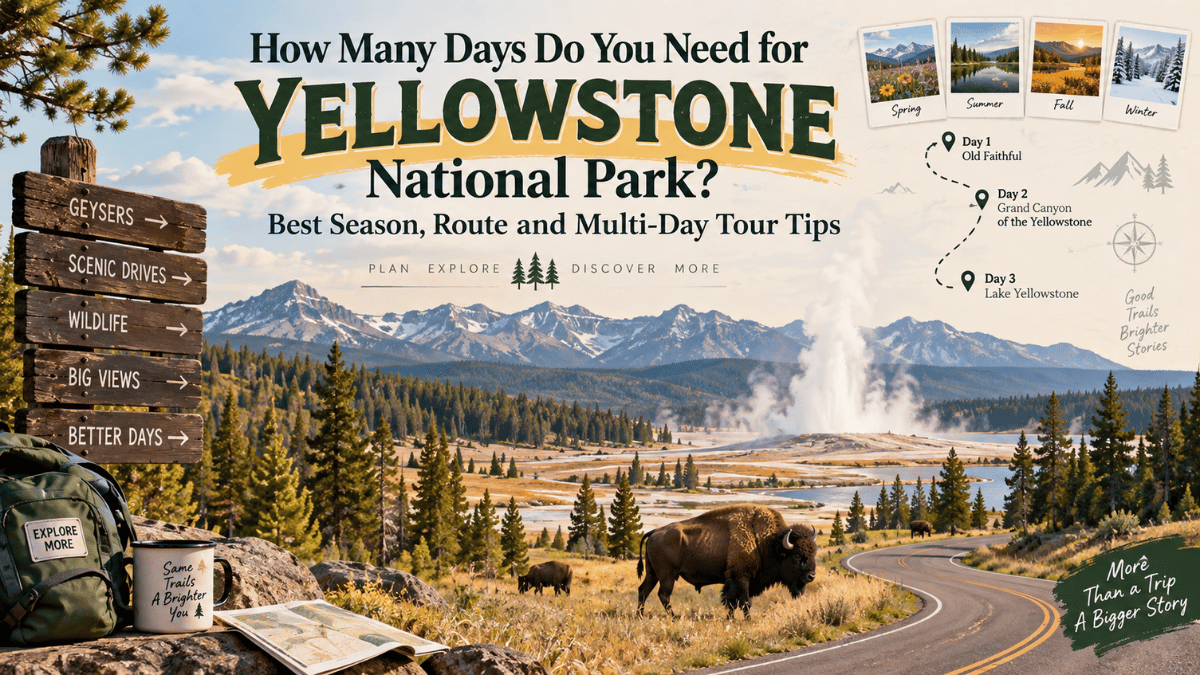
Most first-time visitors need three full days in Yellowstone National Park. That is enough time to devote one day to the geyser basins, one to the canyon and lake area, and one to the wildlife-rich northern loop without turning every stop into a race. Two days can cover headline sights if you start early and accept long drives; four days gives you room for short hikes, wildlife delays, and changing weather. Count only days spent inside the park—not the day you fly into Salt Lake City or Las Vegas. If Yellowstone is part of a wider Western vacation, a five- or seven-day escorted itinerary can be more efficient because transportation and the sequence of distant parks are already organized.
How Many Days Should You Spend in Yellowstone
The answer depends on how you travel. Yellowstone has five entrances, two large road loops, slow traffic, and unpredictable wildlife jams. Allow two days for highlights, three for a balanced first visit, and four or five for hiking, photography, or a relaxed pace.
A one-day visit works only if you choose one priority rather than attempt the entire Grand Loop. For a broader trip through the United States, reserve travel days separately and protect at least two nights near Yellowstone. Families, visitors with limited mobility, and anyone who enjoys boardwalks at an unhurried pace should lean toward three or four days.
| Time in the Park | Best For | Realistic Focus | Main Tradeoff |
| 1 day | Road-trip stopovers | One zone, such as Old Faithful and nearby geyser basins | You miss most of the park |
| 2 days | Fast highlights trips | Lower Loop one day, canyon and wildlife areas the next | Little flexibility |
| 3 days | Most first-time visitors | Thermal features, canyon and lake, plus the northern range | Longer hikes remain limited |
| 4–5 days | Hikers and photographers | Major areas plus trails, repeat wildlife drives, and weather buffer | Higher lodging and transport cost |
A one-day visit works only if you choose one priority rather than attempt the entire Grand Loop. For a broader trip through the United States, reserve travel days separately and protect at least two nights near Yellowstone. Families, visitors with limited mobility, and anyone who enjoys boardwalks at an unhurried pace should lean toward three or four days.
Best Season for Yellowstone: Access Versus Crowds

For the easiest first visit, choose June through September, when the greatest share of roads, facilities, and activities is normally accessible. July and August bring the warmest conditions and fullest services, but also peak crowds. Start before 7 a.m. and visit famous thermal areas later in the afternoon when possible.
Late May and September often provide the best balance. In May, snow may linger and higher-elevation conditions can still change, while roads generally open progressively and are typically all open by Memorial Day weekend if weather cooperates. September usually keeps the road network accessible, offers cooler nights, and brings seasonal wildlife interest, but some campgrounds and lake services begin closing. Check park road and operating information immediately before departure.
October is appealing for fewer people and autumn atmosphere, yet snow becomes more likely and some high routes close during the month. Winter is a specialized trip: most park roads close to regular cars, while the road between the North and Northeast entrances is generally the only one open year-round to ordinary vehicles, weather permitting. Snowcoach or snowmobile access is limited to designated periods and routes. The general Yellowstone destination guide is useful for comparing seasonal trip styles before committing to dates.
A Practical Three-Day Yellowstone Route

Organize the park by geography, not by fame. This reduces backtracking and leaves space for animal sightings, road delays, and longer-than-expected boardwalk stops.
Day 1: Old Faithful and the Geyser Basins
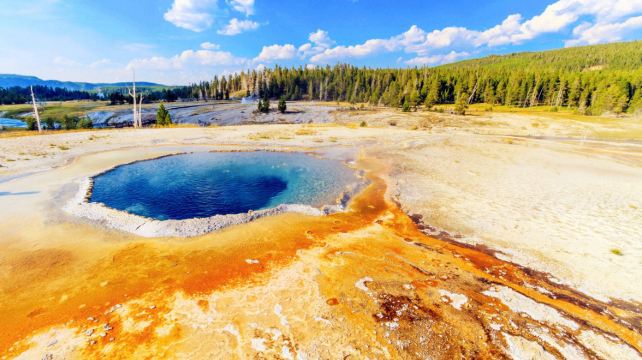
Start in the southwest with Old Faithful and Upper Geyser Basin. Then move toward Midway Geyser Basin and Grand Prismatic Spring, followed by one or two smaller thermal areas if time permits. Thermal features require staying on boardwalks and respecting closures. Do not schedule a distant evening stop; eruption timing, parking, and walking can easily expand the day.Day 2: Yellowstone Lake, Hayden Valley, and the Canyon
Travel through the lake area, stop at West Thumb if it fits your direction, and continue through Hayden Valley toward the Grand Canyon of the Yellowstone. Choose a manageable combination of overlooks rather than driving to every viewpoint. Wildlife can stop traffic in Hayden Valley, so treat sightings as part of the experience instead of a disruption to a rigid schedule.Day 3: Mammoth, Lamar Valley, and the Northern Loop
Begin early for Lamar Valley, then connect the northern range with Mammoth Hot Springs. This day is strongest for travelers who value wildlife and broad landscapes. If you are combining the park with Grand Teton, the 5-Day Yellowstone, Grand Teton, and Salt Lake City tour fits visitors who want an organized regional route and a Salt Lake City start. Its routing links two national parks in one trip; the tradeoff is less control over how long you remain at each Yellowstone stop.Recommend Tour


4.9
( 81 reviews )
Tour Code: 728205Start / End City
Salt Lake City
Duration
5.0 Days
City & Attractions
Salt Lake City, Jackson, Park County
+23 more
Languages
Chinese Live, English Live
Group Size
Max. 13 travelers
Tour Audience
Primarily Mandarin-Speaking Travelers
Save 20%
From $1,195.95
$956.76
Last-Minute Deals
When a Five- or Seven-Day Multi-Park Tour Makes Sense
A packaged itinerary is useful when the challenge is connecting Yellowstone with distant airports and parks. Compare actual Yellowstone sightseeing days, start and end cities, road time, and whether the additional destinations match your priorities. Browse Yellowstone tour package options by route rather than assuming a longer tour means more time inside Yellowstone.
Travelers who want the broadest Southwest-and-Rockies sampler can consider the 7-Day Yellowstone, Antelope Canyon, and Grand Canyon tour. It suits first-time Western visitors who prefer one continuous itinerary across several iconic landscapes. The clear benefit is combining Yellowstone with two major canyon destinations; the honest tradeoff is substantial distance, so the trip emphasizes variety more than deep exploration of any single park.
Travelers who want the broadest Southwest-and-Rockies sampler can consider the 7-Day Yellowstone, Antelope Canyon, and Grand Canyon tour. It suits first-time Western visitors who prefer one continuous itinerary across several iconic landscapes. The clear benefit is combining Yellowstone with two major canyon destinations; the honest tradeoff is substantial distance, so the trip emphasizes variety more than deep exploration of any single park.
Recommend Tour

4.9
( 73 reviews )
Tour Code: 720834Start / End City
San Francisco, Sacramento, Las Vegas
Duration
7.0 Days
City & Attractions
Las Vegas, Salt Lake City, Jackson
+32 more
Languages
Chinese Live, English Live
Group Size
Max. 13 travelers
Tour Audience
Primarily Mandarin-Speaking Travelers
Save 30%
From $1,366.80
$956.76
For a shorter Las Vegas-based circuit, the 5-Day Yellowstone tour from Las Vegas with Zion and Grand Teton fits travelers with limited vacation time who want multiple parks plus Horseshoe Bend, Lake Powell, and Yellowstone Bear World along the route. It solves complex point-to-point planning, but its ambitious scope means brisk sightseeing and more time in transit than a Yellowstone-only stay.
Recommend Tour

5.0
Tour Code: 748920Start / End City
Las Vegas, Salt Lake City
Duration
5.0 Days
City & Attractions
Salt Lake City, Jackson, Page
+31 more
Languages
Chinese Live, English Live
Group Size
Max. 13 travelers
From
$1,103.43
If your priority is thermal geology, wildlife watching, or hiking, choose the itinerary with the most time inside Yellowstone, even if it visits fewer places. If your priority is a first survey of the American West, the multi-park route may deliver more value. Tours4fun can serve as a starting point for comparing the geography of these circuits, while the day-by-day route should decide the final choice.
Multi-Day Planning Tips That Protect Your Time
- Sleep strategically.Staying inside the park or near the entrance closest to the next morning’s first stop reduces repeated driving. Changing lodging once can be worthwhile on a three- or four-day visit.
- Build one flexible block per day. Keep an hour or two unassigned for wildlife jams, an eruption wait, weather, parking, or a spontaneous short trail.
- Start with priority stops. Visit your essential thermal basin, canyon viewpoint, or wildlife valley early. Treat later stops as optional rather than racing to complete a checklist.
- Check conditions daily. Road status and weather can change quickly, including during summer. Download maps before entering because mobile coverage is inconsistent.
- Pack for temperature swings. Mornings and evenings can be cold even after warm afternoons. Carry layers, water, sun protection, and rain gear.
- Keep wildlife distance. Use roadside pullouts, remain far from animals, and never stop in a traffic lane. A telephoto lens or binoculars improves viewing without unsafe approaches.
Distinguish tour length from park time. A five-day itinerary starting far away may devote fewer days to Yellowstone than a three-night independent stay near an entrance. Read the sequence, identify overnight locations, and count the hours available in each park.