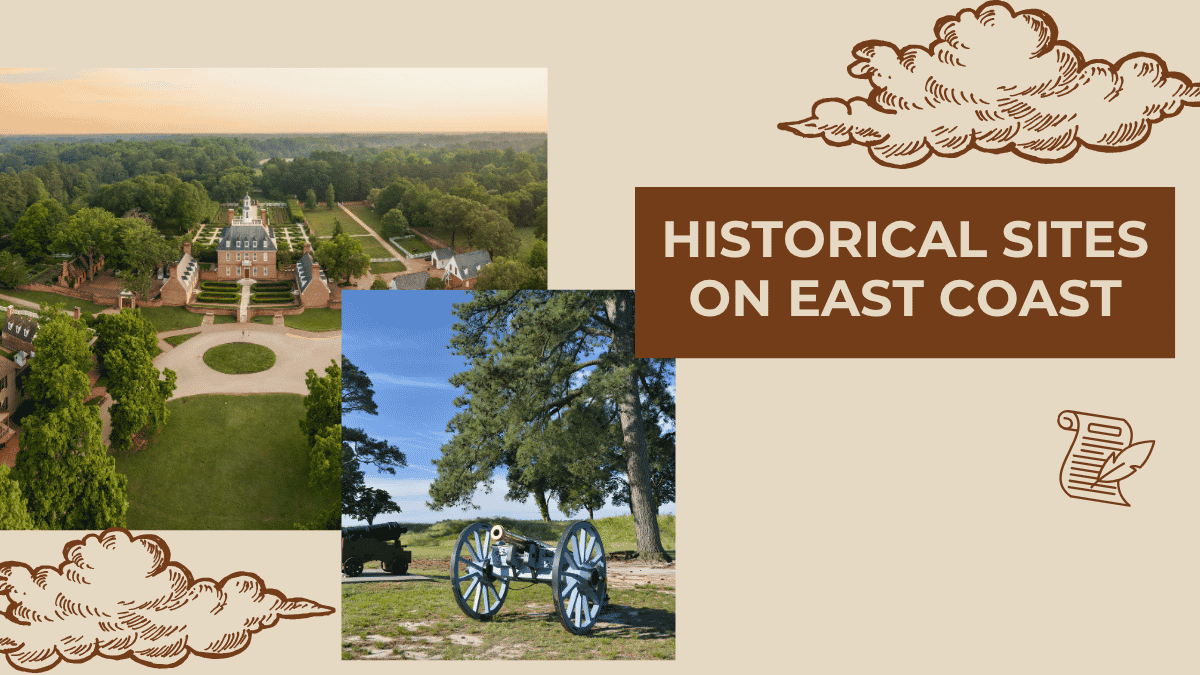
Best Historical Places to Visit on the East Coast
What makes the East Coast so special for history lovers is the sheer density of it all. You can trace almost 400 years of American life without leaving a few hundred miles of coastline: colonial settlements, Revolutionary War battlegrounds, Civil War sites, and Gilded Age mansions all sit within a reasonable drive of each other. Here are some historical sites on the East Coast that you might find interesting.
1. Jamestown, Virginia
Jamestown holds the title of the first permanent English settlement in America, founded way back in 1607. Walking through the reconstructed fort and archaeological dig sites here feels like flipping through the opening chapter of American history. You can watch archaeologists actively working at Historic Jamestowne, since excavations are still ongoing more than four centuries later.
Jamestown Settlement, the living-history museum next door, adds replica ships and a Powhatan village so you get multiple perspectives on that first, difficult chapter of colonization. Bring comfortable shoes because you'll want to wander the riverbank where it all started.

2. Colonial Williamsburg, Virginia
Colonial Williamsburg turns an entire town into a time machine. Costumed interpreters bake bread, forge tools, and debate politics exactly as colonists did in the 1700s. You can chat with a blacksmith about his trade or sit in on a mock trial in the courthouse. Kids especially love this one because it's hands-on rather than just plaques and roped-off rooms. Give yourself at least a full day here, since the site covers 301 acres and there's genuinely a lot to see.

3. Yorktown Battlefield, Virginia
This is where the Revolutionary War essentially ended. British General Cornwallis surrendered here in 1781, and you can still walk the earthworks and cannon positions where the final siege played out. The visitor center does a great job explaining the strategy behind the battle, and the surrounding battlefield tour lets you picture the troop movements firsthand. Pair a visit here with Jamestown and Williamsburg, since all three sit along Virginia's Historic Triangle and make for an easy day-trip loop.

4. Mount Vernon, Virginia
George Washington's plantation home sits on a gorgeous bluff overlooking the Potomac River, and honestly, the setting alone is worth the drive. You'll tour the mansion, walk the gardens, and see the tomb where Washington and his wife Martha are buried. What makes Mount Vernon stand out is its honest treatment of the enslaved community who lived and worked there; recent additions to the site dig into those stories rather than glossing over them.

5. Monticello, Virginia
Thomas Jefferson designed Monticello himself, and the house reflects his restless curiosity almost as much as it reflects the era. You'll spot inventions like a dumbwaiter and a revolving bookstand tucked throughout the home. Like Mount Vernon, Monticello now includes powerful exhibits about the enslaved individuals who built and maintained the estate, giving visitors a fuller understanding of daily plantation life.

6. Harpers Ferry, West Virginia
Harpers Ferry sits at the meeting point of two rivers and two states' worth of dramatic scenery, but its real claim to fame is John Brown's 1859 raid on the federal armory here. That single event pushed the country closer to civil war. The town itself looks frozen in the 19th century, with steep cobblestone streets and preserved storefronts.

7. Plymouth Colony, Massachusetts
Plymouth is where the Mayflower Pilgrims settled in 1620, and Plimoth Patuxet Museums recreates that world with remarkable detail. Actors portray actual historical figures and speak in period dialect, which makes conversations here feel oddly real. You'll also find Plymouth Rock itself, a modest boulder that carries an outsized amount of symbolic weight. Don't skip the Wampanoag Homesite either, since it offers a Native perspective that balances out the settler-focused narrative you'll find elsewhere.

8. Boston Freedom Trail, Massachusetts
The Freedom Trail is a 2.5-mile red-brick path connecting 16 historic sites, including the Old North Church, Paul Revere's House, and the Bunker Hill Monument. You can walk it in an afternoon, stopping wherever catches your interest. What's great about this trail is how it condenses so much Revolutionary-era history into a genuinely walkable route through a modern, lively city. Grab a cannoli in the North End while you're at it; you've earned it after all that walking.

9. Salem Witch Trials Sites, Massachusetts
Salem's 1692 witch trials remain one of the darkest chapters in colonial history, and the town doesn't shy away from that legacy. The Salem Witch Museum and the Witch Trials Memorial both offer sobering, thoughtful looks at what happened to the 20 people executed on false accusations. Beyond the witch trial sites, Salem's maritime history and its charming downtown make it worth a full day.

10. Independence Hall, Pennsylvania
This is the building where the Declaration of Independence and the Constitution were both debated and signed. Standing in the Assembly Room, where delegates argued over the future of a brand-new country, gives you chills whether you're a history nerd or not. Independence Hall sits within Independence National Historical Park, so you can also see the Liberty Bell right across the street. Tickets are free, but they go fast, so plan.

11. Valley Forge National Historical Park, Pennsylvania
Valley Forge marks where Washington's Continental Army camped during the brutal winter of 1777-78. Roughly 2,000 soldiers died here from disease and exposure, yet the army emerged the following spring more disciplined than ever. Today the park features reconstructed log huts, miles of hiking and biking trails, and a museum that puts the sacrifice of that winter into sharp perspective. It's a quieter, more reflective stop compared to some of the busier sites on this list.

12. Gettysburg National Military Park, Pennsylvania
Gettysburg saw the bloodiest battle of the Civil War, a three-day clash in July 1863 that turned the tide of the entire war. The battlefield today spans thousands of acres, dotted with monuments from nearly every state that sent troops. A guided auto tour or licensed battlefield guide helps make sense of the massive scale of the fighting. The museum and visitor center also house the Gettysburg Cyclorama, a massive 360-degree painting depicting Pickett's Charge that really puts you in the moment.

13. Antietam National Battlefield, Maryland
Antietam holds a grim distinction: it was the single bloodiest day in American military history, with roughly 23,000 casualties in one day of fighting back in September 1862. The battlefield remains remarkably preserved, with cornfields, a sunken road nicknamed "Bloody Lane," and the iconic Burnside Bridge all still standing. Walking this quiet, rural landscape and picturing the carnage that unfolded here is a sobering, powerful experience.

14. Harriet Tubman Underground Railroad National Historical Park, Maryland
This park sits in the marshy Eastern Shore landscape where Harriet Tubman was born into slavery and later guided dozens of others to freedom. The visitor center tells her story through personal artifacts and firsthand accounts, while the surrounding Underground Railroad Byway lets you drive through the actual terrain she navigated at night. It's a moving tribute to one of American history's most courageous figures.
15. Fort McHenry National Monument, Maryland
Fort McHenry's defense against British bombardment in 1814 inspired Francis Scott Key to write what eventually became "The Star-Spangled Banner." You can walk the star-shaped fort's ramparts, check out restored barracks, and watch the flag-raising ceremony that happens regularly throughout the day. The harbor views from the fort walls are a nice bonus, especially at sunset.
16. St. Augustine Historic District, Florida
St. Augustine claims the title of the oldest continuously occupied European-founded city in the United States, dating back to 1565. The Castillo de San Marcos, a striking coral-stone fortress, anchors the historic district and gives you a totally different colonial story than the English settlements up north. Cobblestone streets, Spanish colonial architecture, and horse-drawn carriage tours make this one of the more charming historical places to visit on the East Coast.

17. Fort Sumter National Historical Park, South Carolina
The Civil War's first shots rang out here in April 1861, making Fort Sumter one of the most consequential historic sites in the country. You'll need to catch a ferry from Charleston to reach the fort itself, and the boat ride across the harbor is a scenic way to build anticipation. Once there, ranger talks and preserved cannon emplacements explain exactly how the war began.
18. Biltmore Estate, South Carolina
While the Biltmore Estate is technically located just over the border in Asheville, North Carolina, its Gilded Age grandeur earns it a spot on any East Coast history itinerary. Built by George Vanderbilt in the 1890s, it remains America's largest privately owned home. Touring the 250-room French Renaissance chateau, then wandering the Olmsted-designed gardens, shows you a completely different side of American history than the colonial and Civil War sites elsewhere on this list.

19. Fort Raleigh National Historic Site, North Carolina
Fort Raleigh preserves the site of the "Lost Colony," England's first attempt at a permanent American settlement in 1587. The colonists vanished without a clear explanation, leaving behind one of history's most enduring mysteries. The site includes a reconstructed earthwork fort and an outdoor theater where a summer drama retells the colony's story. If you love a good mystery mixed with your history, this stop delivers.
20. Morris-Jumel Mansion, New York
Tucked away in upper Manhattan, Morris-Jumel Mansion is the oldest surviving house in the borough, dating to 1765. George Washington used it briefly as headquarters during the Revolutionary War, and the home later became the residence of Aaron Burr. The Georgian-style architecture and period furnishings offer a quiet contrast to the busy city surrounding it. Few visitors realize such a well-preserved slice of the 18th century exists just steps from Harlem.
 Beyond My Ken, CC BY-SA 4.0, via Wikimedia Commons
21. Cape May Historic District, New Jersey
Cape May is packed with more than 600 Victorian-era buildings, making it one of the largest concentrations of Victorian architecture in the country. This seaside town became a resort destination in the 19th century, and many of those original gingerbread-trimmed houses still stand today. Trolley tours and walking tours let you soak in the pastel-painted homes while also enjoying Cape May's beaches and lighthouse.

22. Newport Historic District, Rhode Island
Cape May is packed with more than 600 Victorian-era buildings, making it one of the largest concentrations of Victorian architecture in the country. This seaside town became a resort destination in the 19th century, and many of those original gingerbread-trimmed houses still stand today. Trolley tours and walking tours let you soak in the pastel-painted homes while also enjoying Cape May's beaches and lighthouse.

FAQ
What is a must-see on the East Coast?
Independence Hall in Philadelphia ranks among the most essential stops, since it's literally where the Declaration of Independence and Constitution were debated and signed. If you only have time for one site, this is a strong pick.What is the most historic place in the USA?
Jamestown, Virginia, often earns this title as the first permanent English settlement in America, founded in 1607. St. Augustine, Florida, also has a strong claim as the oldest continuously occupied European-founded city, dating back to 1565.What is the most beautiful town on the East Coast?
Newport, Rhode Island, and Cape May, New Jersey, both stand out for their architecture and coastal charm. Newport pairs colonial-era buildings with Gilded Age mansions, while Cape May offers one of the largest collections of Victorian homes in the country.